






Celebrating Our Heroes and Heroines
The Celestial Church of Christ was established through the calling and anointing of God upon the Pastor Founder, Prophet Rev. Pastor Samuel Bilehou Joseph Oshoffa, and through the contributions of several people whom God used in different ways during the Church’s formation and early growth.
Thank you for reading this post, don't forget to subscribe!Throughout this month of celebrating our heroes and heroines, we are remembering those contributions with gratitude. Some people appear in the history through their service, some through counsel, and others through the experiences and testimonies preserved about them.
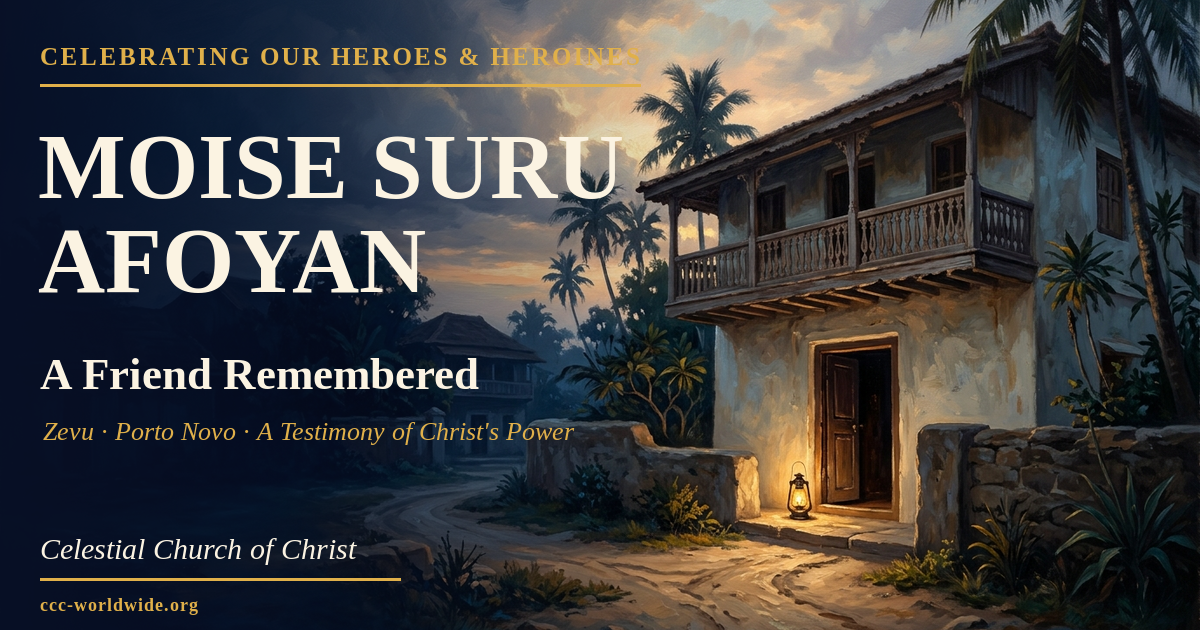
Today, we remember Moise Suru Afoyan, a friend of the Pastor Founder whose story appears in the Church’s constitutional account.
His remembrance invites us to reflect on friendship, compassion, and the power of Jesus Christ—the same Lord who called His friend Lazarus from the tomb.
A friend remembered by name
In paragraph 35, Papa Oshoffa identifies Moise Suru Afoyan of the Zevu district of Porto Novo as his friend. Moise’s relatives came to tell the Founder that he had died; they had come to buy a coffin and had only called to let him know.
I went to the house of MOISE and I saw his dead body lying on the floor. He was my friend. … When it was the wish of Jesus, MOISE SURU was brought back to life at twelve midnight.
— Papa Oshoffa, Makoko, 18 January 1969
CCC Constitution (Nigeria Diocese, 1980), paragraph 35
Within this spiritual account is a personal relationship: the Founder was responding to news concerning someone he knew as a friend. “He was my friend.”
That detail gives this remembrance a particular depth.
A reminder of Jesus and His friend Lazarus
For Christians, the account brings to mind Jesus and Lazarus in John 11.
The Gospel describes Jesus’ love for Lazarus and his sisters, Martha and Mary. When Jesus encountered their sorrow, He wept. He then called Lazarus from the tomb.
In that biblical account, we encounter both the compassion of Jesus and His authority over death.
The parallel helps us reflect on Moise’s story. Papa Oshoffa speaks of his friend and credits Jesus with restoring him to life. Within the Church’s testimony, the Founder presents himself as a servant through whom Christ worked.
The glory belongs to Jesus Christ.
We can therefore remember Moise’s experience as part of the Church’s testimony to the Lord whom Christians confess as the resurrection and the life.
Biblical reflection: John 11:1–44.
The testimony Moise shared afterwards
The next day, Moise told the Founder what he had seen: an old man with white hair and beard, standing on the balcony of a storey building, who told him he would be returned to life to honour the Pastor, and would not die again until the one who raised him had built a storey building. (CCC Constitution, paragraph 36)
Papa Oshoffa adds that at the time he “did not even have the financial strength to buy a single brick”. Yet in 1969 he could say: “MOISE SURU and his children are still alive today, and the storey building has been built in his lifetime as he foretold.” (CCC Constitution, paragraph 37)
The Founder himself credits Moise with foretelling it: “It was thus MOISE SURU who foretold the event of my building a storey house.” This testimony gives Moise another place in the recorded history.
The account does not describe him financing the house or provide a full biography of his later life. We honour what it preserves without adding achievements it does not establish.
Friendship includes standing beside others
The story of Lazarus shows Jesus entering a place of grief. The constitutional account concerning Moise also begins with news of death reaching a friend.
For devotional reflection, these accounts encourage us to consider how we respond when people close to us suffer.
Do we make time to visit?
Can we listen when someone needs to speak about their loss?
Are we willing to offer help when there is no easy answer?
People who mourn need compassion and dependable support. A meal, a visit, assistance with practical arrangements, or a quiet presence can communicate care.
Faith should deepen our willingness to stand beside others in sorrow.
Hope in Christ and compassion for those who grieve
The account of Lazarus gives Christians a profound expression of hope. It also preserves the tears of Jesus.
That matters for the way we care for one another.
Grief should be met with patience. We should allow people to mourn without questioning the sincerity of their faith. We can pray with them, listen to them, and support them through the days and months that follow.
Our hope in Christ should make us more compassionate towards those experiencing loss.
As we remember Moise, let us reflect on the care we offer the bereaved in our own families and parishes.
Preserving testimony with care
Moise’s story also reminds us of the responsibility involved in passing on spiritual accounts.
We should identify our sources, communicate accurately, and distinguish the recorded event from the reflections we draw from it.
Here, we are reading the Church’s constitutional testimony alongside the biblical account of Lazarus. The connection between them is a devotional reflection on friendship, compassion, and Christ’s power.
Careful retelling honours the people in the account and helps younger generations understand the history they inherit.
A place in our shared remembrance
Our heroes-and-heroines series includes people whose contributions took different forms.
Moise’s place rests on the experience and testimony recorded about him. Remembering him allows us to recognise another relationship within the Church’s early history.
It also encourages us to consider the legacy of our own friendships.
Are we dependable?
Do we speak truthfully?
Do we remain present when someone’s circumstances become difficult?
These are ways we can serve faithfully in our generation.
Our hero deserves remembrance
Today, we remember Moise Suru Afoyan—the Founder’s friend whose restoration and testimony are preserved in the Constitution.
His story brings to mind Jesus and His friend Lazarus, directing our reflection towards the compassion and power of Christ.
May we become more faithful friends, more patient companions to those who mourn, and more careful keepers of the testimony entrusted to us.
We remember the people. We honour their place in the story. We give the glory to God.
Historical basis: Constitution of the Celestial Church of Christ (Nigeria Diocese, 1980), foundation history told by Papa Oshoffa at Makoko on 18 January 1969, paragraphs 35–37. Biblical reflection: John 11:1–44. Spiritual events are presented as recorded in the Church’s account; the connection with Lazarus and the reflections on friendship and hope are devotional applications. The picture is an illustration: no photograph of him is used.
#CelestialChurchOfChrist #MoiseSuruAfoyan #JesusAndLazarus #CelebratingOurHeroes #HeroesAndHeroines #ChurchHistory #Testimony #FaithAndFriendship
@followers #followerseveryone #followmeonfacebook #follower #followformore #followersreels #followforfollowback
💬 Questions or need prayer? We are here any time:
- ☎️ 1-844-7-CCC-HUB (844-722-2482) – Toll-free: call free - ask Grace (LULI) any question, or ask her for prayer and our Prayer Minister or Comfort will pray with you right on the call. Text JOIN for service and event updates (Call · Text JOIN)
- 📱 959-CCC-CHUB (959-222-2482) – Call - ask Grace (LULI) any question, or ask her for prayer and our Prayer Minister or Comfort will pray with you right on the call - or chat with Grace on WhatsApp (Call · WhatsApp)
- 💬 +1 771-233-5885 – Chat with Grace (LULI) on WhatsApp: questions, prayer requests and more (WhatsApp)



Do you know more about Moise Suru Afoyan?
Perhaps an elder in your parish, in Porto Novo or elsewhere, or someone from his family, has told you more about him and his testimony. Join the CCC Worldwide Community and share what you know in the comments below. Joining is free.
Join and comment Already a member? Log in