







Celebrating Our Heroes and Heroines
The Celestial Church of Christ was established through the calling and anointing of God upon the Pastor Founder, Prophet Rev. Pastor Samuel Bilehou Joseph Oshoffa, and through the contributions of several people whom God used in different ways during the Church’s formation and early growth.
Thank you for reading this post, don't forget to subscribe!Throughout this month of celebrating our heroes and heroines, we are remembering those contributions with gratitude. We have reflected on people whose names are preserved alongside their counsel, spiritual gifts, journeys, and service.
Today, we honour a prophetess whose name is not supplied in the relevant constitutional passage, but whose contribution to the Church’s worship is expressly remembered.
She is the prophetess associated with the revelation of the seating arrangement.
The account preserved in the Constitution
Paragraph 94, under the heading “Mode of Worship”, explains that the Church’s forms of worship were received through the Holy Spirit:
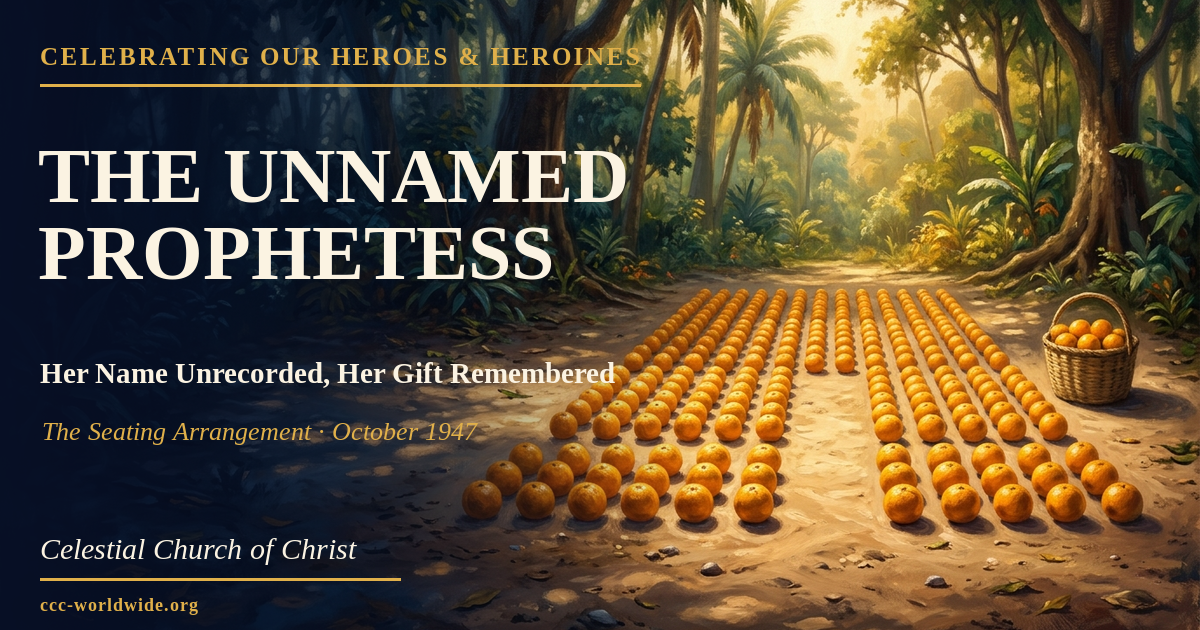
All forms of worship in the Celestial Church of Christ are entirely as revealed by the Holy Spirit. This includes the setting of the altar, and the seats therein, the number of candles used for the various types of services and the seating arrangement. In particular, it should be noted that the seating arrangement was revealed through a prophetess who under the influence of the Holy Spirit in the wilderness on Friday 5th October 1947, sketched the seating arrangement using oranges.
— Constitution of the Celestial Church of Christ
Nigeria Diocese, 1980, paragraph 94
That is the historical foundation for this reflection. It places her contribution in the very first days of the Church, less than a week after the Divine Order of 29 September 1947.
The passage preserves her contribution without giving her name. We should respect that distinction and avoid assigning her an identity that the text does not establish.
An ordinary object in a significant account
One memorable detail is the use of oranges.
For devotional reflection, this invites us to consider how something readily available can become useful in communicating an idea.
We sometimes postpone service because we are waiting for better resources, a more prominent position, or an ideal opportunity. Yet there may already be something within our reach that can help another person.
We may have time to listen, knowledge to share, a practical skill, or a willingness to assist.
Her story encourages us to ask: What can I offer with what is available to me today?
Her contribution deserves attention
The Constitution’s decision to preserve this episode gives us a reason to include her in our celebration.
When we teach the history associated with our worship, we should make room for the people through whom the account says particular instructions were received.
Doing so helps younger generations understand that the history contains many participants. It also allows us to recognise women’s contributions through specific references rather than general statements.
This prophetess belongs in that remembrance, even though this passage does not tell us more about her life.
Remembering people whose names are missing
Historical records do not preserve everyone equally.
Some people are named repeatedly. Others appear briefly, and some are identified only by a role or an action.
That creates a responsibility for us as readers. We can acknowledge the contribution that survives while being honest about what remains unknown.
An unnamed person still deserves thoughtful attention.
This also speaks to the way we recognise service in our own communities. There are people whose work may be familiar while their names are scarcely known: those who prepare a space, help a visitor, care for someone quietly, or make a gathering possible.
We should make an effort to know them, thank them, and recognise their contribution while they are with us.
A lesson in attentive teaching
This story gives parents, teachers, and parish leaders an opportunity to encourage careful learning.
When someone asks about a practice, we can return to the relevant account and read it together. We can explain what the passage says, discuss its meaning, and identify where further research is needed.
That approach builds trust.
It shows that reverence for our history can be accompanied by accuracy. It also teaches younger members that asking a sincere question is part of learning.
We serve our community well when we help people understand the sources behind what we teach.
What we preserve for the future
Remembering this prophetess should also encourage us to document the contributions of people serving today.
Where appropriate, we can preserve names, dates, photographs, testimonies, and parish records with care. We can ask older members about their experiences and record their recollections accurately.
Future generations will depend partly on the care we take now.
Our own celebration of heroes and heroines is an opportunity to strengthen that work: honouring what is recorded, seeking reliable information, and leaving a clearer record for those who follow.
Our heroine deserves remembrance
Today, we honour the unnamed prophetess through whom the Constitution records the revelation of the seating arrangement, illustrated using oranges.
We do not know her name from this passage. We can still recognise her place in the account and reflect on the value of her contribution.
May her remembrance encourage us to serve with what we have, recognise the people around us, and preserve our shared history responsibly.
As our celebration continues, let us remain attentive to those whose contributions deserve gratitude, including those whose names have received little recognition.
We remember the people. We honour their contributions. We give the glory to God.
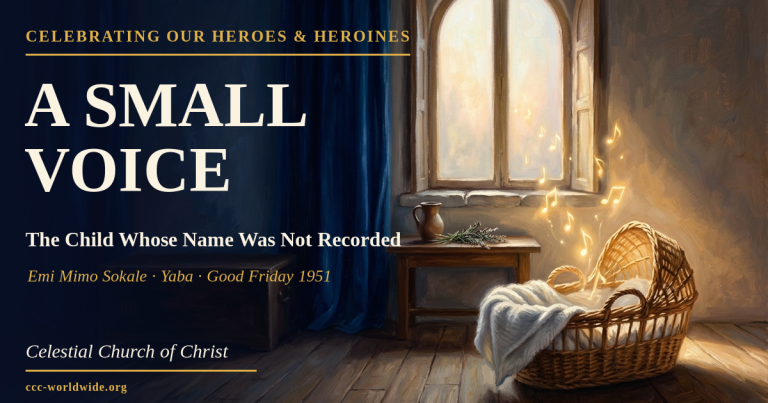
Historical basis: Constitution of the Celestial Church of Christ (Nigeria Diocese, 1980), paragraph 94, “Mode of Worship”. The passage does not identify the prophetess by name. The Constitution dates the revelation “Friday 5th October 1947”; by the calendar, 5 October 1947 fell on a Sunday, so the weekday or the date may have been mistranscribed. Reflections on service, recognition, and historical preservation are devotional applications of the account. The picture is an illustration: no people are shown.
#CelestialChurchOfChrist #CelebratingOurHeroes #HeroesAndHeroines #WomenInChurchHistory #ChurchHistory #FaithAndService #UnsungHeroines
@followers #followerseveryone #followmeonfacebook #follower #followformore #followersreels #followforfollowback
💬 Questions or need prayer? We are here any time:
- ☎️ 1-844-7-CCC-HUB (844-722-2482) – Toll-free: call free - ask Grace (LULI) any question, or ask her for prayer and our Prayer Minister or Comfort will pray with you right on the call. Text JOIN for service and event updates (Call · Text JOIN)
- 📱 959-CCC-CHUB (959-222-2482) – Call - ask Grace (LULI) any question, or ask her for prayer and our Prayer Minister or Comfort will pray with you right on the call - or chat with Grace on WhatsApp (Call · WhatsApp)
- 💬 +1 771-233-5885 – Chat with Grace (LULI) on WhatsApp: questions, prayer requests and more (WhatsApp)





Do you know who she was?
Perhaps an elder in your parish, in Porto Novo or elsewhere, has heard who the prophetess was, or how the seating arrangement was first shown. We will only add a name if it can be confirmed. Join the CCC Worldwide Community and share what you know in the comments below. Joining is free.
Join and comment Already a member? Log in