

Celebrating Our Heroes and Heroines
The Celestial Church of Christ was established through the calling and anointing of God upon the Pastor Founder, Prophet Rev. Pastor Samuel Bilehou Joseph Oshoffa, and through the contributions of several people whom God used in different ways during the Church’s formation and early growth.
Thank you for reading this post, don't forget to subscribe!Throughout this month of celebrating our heroes and heroines, we are remembering those contributions with gratitude. We have reflected on people who offered counsel, received spiritual revelations, accompanied the mission, carried messages, and helped the Church reach new communities.
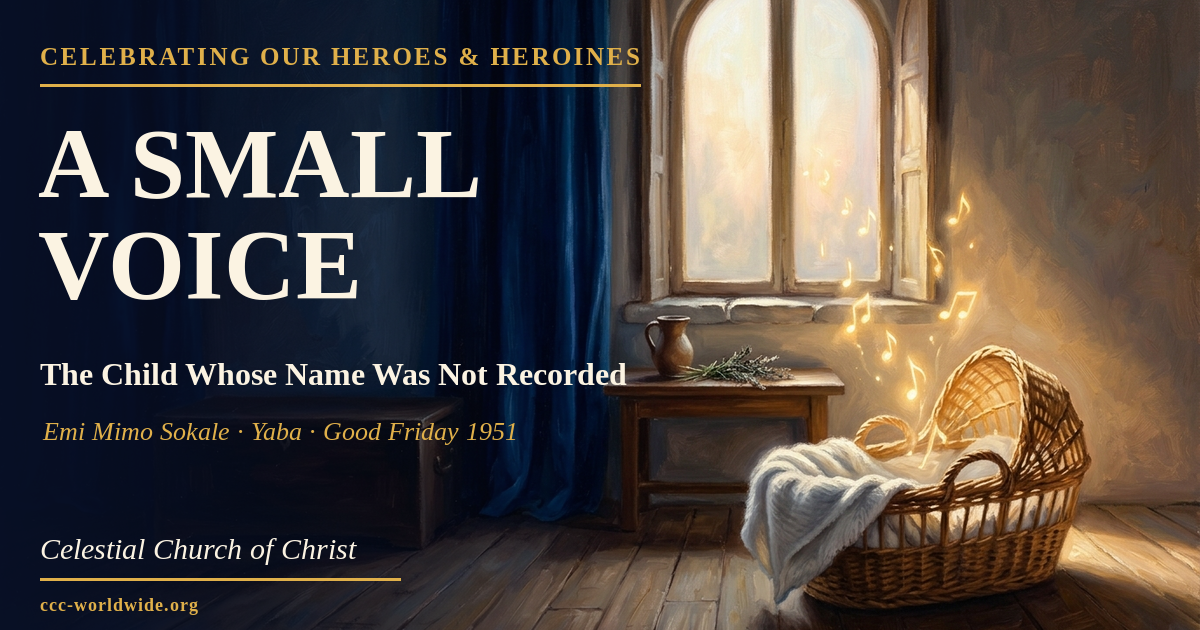
Today, we remember the eleven-month-old child of Marie Zevunnu, whose place in the constitutional account invites us to reflect on children, spiritual gifts, and the importance of remembering those whose names are not preserved.
The account recorded in the Constitution
On Good Friday 1951, a few days after he first arrived in Lagos, Papa Oshoffa met clergymen from several churches in a hall in Yaba. They wished to see the glory of God before they would believe. After an hour, nothing had happened. Then, the Founder recalled:
I then remembered and sang the song which the eleven month old child of MARIE ZEVUNNU gave, the world through the HOLY SPIRIT some time before …
— Papa Oshoffa, Makoko, 18 January 1969
CCC Constitution (Nigeria Diocese, 1980), paragraph 47
The song begins “Emi Mimo sokale sarin wa” (“O! Holy Ghost descend thou upon us”). Paragraph 48 describes what followed: as they sang, the Holy Spirit descended upon those gathered, and “the whole hall shook”. (CCC Constitution, paragraphs 45–48)
The passage identifies the child through the mother and age. It does not supply the child’s name or explain precisely how the song was communicated.
We should preserve those limits while remembering the contribution the account attributes to this child.
A child’s place in our shared history
This is a striking inclusion in the founding narrative.
The account gives a very young child a place in the history associated with the Church’s worship. For believers reflecting on it, this offers a reason to consider how we recognise children within our spiritual communities.
Children are members of our families and congregations whose dignity deserves attention now.
They need safety, affection, patient teaching, and opportunities to participate in ways appropriate to their age and understanding.
Our regard for them should be visible in how we listen, teach, organise gatherings, and respond when they need help.
The invitation to depend on God
The song remembered in this passage is an appeal for the Holy Spirit’s presence and strength. Read the song within the constitutional account.
For devotional reflection, such an appeal asks us to acknowledge our need for God.
Those who lead and serve can become absorbed in preparation, responsibilities, and expectations. Prayer creates space to bring those concerns before God with humility.
We can prepare diligently and still recognise that we need wisdom.
We can accept responsibility while remaining willing to learn.
We can seek strength without pretending that we are never tired or uncertain.
These attitudes help us serve others with greater care.
Remembering the child alongside the mother
Marie Zevunnu’s name is the identifying connection preserved in this passage.
That detail reminds us to pay attention to family relationships within historical accounts. A record may preserve one person’s name while identifying another through a parent, spouse, or relative.
When we teach this story, we should be clear about whose contribution the passage describes. It attributes the reception of the song to the child.
Careful retelling allows us to honour the account without confusing the people within it.
No name, but a place in the record
Not every person remembered in a community’s history leaves behind a detailed biography.
Some are known through a brief action. Others are identified by a role, a relationship, or an age.
Their limited description should encourage thoughtful remembrance. We can acknowledge what survives and remain honest about what we do not know.
This also challenges us to preserve the stories of people serving among us today. Accurate names, dates, recollections, and records can help future generations understand the community they inherit.
A responsibility towards children today
As we remember this child, let us consider the care we offer children in our own parishes.
Do our teaching methods help them understand?
Do they have trusted adults who listen?
Are their needs considered when we plan services and activities?
Do we encourage participation patiently, without placing adult expectations upon them?
A celebration of history becomes meaningful when it strengthens our conduct in the present.
We honour children best through consistent care and responsible attention.
A small voice deserving remembrance
Today, we remember Marie Zevunnu’s eleven-month-old child, to whom the Constitution attributes the reception of a song later recalled by Papa Oshoffa at Yaba.
The child’s name is not supplied in this passage, but the contribution remains part of the recorded story.
May this remembrance encourage humility in our worship, care in our teaching, and greater attentiveness to the children entrusted to our communities.
We remember the people. We honour their contributions. We give the glory to God.
Historical basis: Constitution of the Celestial Church of Christ (Nigeria Diocese, 1980), “Entry into Nigeria”, paragraphs 45–48, especially paragraph 47. The passage does not name the child or describe how the song was communicated. The Constitution spells the mother’s name “Zevunnu” here; it does not say whether she is the Marrie Zevenu of paragraph 25. Reflections on prayer, children, and care are devotional applications of the account. The picture is an illustration: no people are shown.
#CelestialChurchOfChrist #CelebratingOurHeroes #HeroesAndHeroines #ChurchHistory #CelestialHymns #ChildrenInTheChurch #FaithAndService
@followers #followerseveryone #followmeonfacebook #follower #followformore #followersreels #followforfollowback
💬 Questions or need prayer? We are here any time:
- ☎️ 1-844-7-CCC-HUB (844-722-2482) – Toll-free: call free - ask Grace (LULI) any question, or ask her for prayer and our Prayer Minister or Comfort will pray with you right on the call. Text JOIN for service and event updates (Call · Text JOIN)
- 📱 959-CCC-CHUB (959-222-2482) – Call - ask Grace (LULI) any question, or ask her for prayer and our Prayer Minister or Comfort will pray with you right on the call - or chat with Grace on WhatsApp (Call · WhatsApp)
- 💬 +1 771-233-5885 – Chat with Grace (LULI) on WhatsApp: questions, prayer requests and more (WhatsApp)

Do you know more about this child or this song?
Perhaps an elder in your parish has told you about the Zevunnu family, or about how “Emi Mimo sokale sarin wa” was first sung. We will only add a name if it can be confirmed. Join the CCC Worldwide Community and share what you know in the comments below. Joining is free.
Join and comment Already a member? Log in