






“Things fall apart; the center cannot hold.” A prophet did not write those famous words, yet they describe a prophet’s problem. Every generation faces a critical moment. The old foundations groan under pressure. Broken walls no longer hold back chaos. Watchmen either sound the alarm or fall asleep at the gate. We stand in such a moment today. The Word of God already tells us how to respond: we must rebuild, and we must rebuild now.
Thank you for reading this post, don't forget to subscribe!This is not a call to nostalgia. We are not longing for an imaginary golden age. Instead, Scripture gives us an urgent mandate. When walls fall and gates burn, God does not call His people to mourn indefinitely. He commands us to rise up and build.

The Ruins Are Real
Nehemiah did not learn of Jerusalem’s condition from a vision. He learned it from a report: “The remnant that are left of the captivity there in the province are in great affliction and reproach: the wall of Jerusalem also is broken down, and the gates thereof are burned with fire” (Nehemiah 1:3). When he heard it, he did not shrug it off as someone else’s burden. Scripture says, “I sat down and wept, and mourned certain days, and fasted, and prayed before the God of heaven” (Nehemiah 1:4).
That is the first mark of a true rebuilder. He feels the ruin before he fixes it. Too many believers have grown numb to surrounding devastation. We see broken marriages, weakened churches, and fractured families. We witness broken justice and fading confidence in the household of faith. Many people drive past the rubble every day and call it normal. Nehemiah refused to accept rubble as normal. Neither should we.
The Psalmist asked a piercing question for every generation: “If the foundations be destroyed, what can the righteous do?” (Psalm 11:3). This question does not paralyze us. Rather, it provokes a faithful response. God’s answer throughout Scripture remains consistent: the righteous rise, assess the damage, and rebuild.
God Has Always Been a Rebuilding God
Throughout redemptive history, God reveals Himself as the great Restorer. Isaiah prophesied of a people whom God would name “the repairer of the breach, the restorer of paths to dwell in” (Isaiah 58:12). Notice what precedes that promise in Isaiah’s prophecy: fasting, justice, feeding the hungry, and breaking every yoke. Rebuilding is never merely architectural. It begins as a moral and spiritual renewal before it becomes structural. God restores righteousness first, and tangible restoration follows.
The prophet Amos delivered a word that the apostles later cited to describe the mission of the Church: “In that day will I raise up the tabernacle of David that is fallen, and close up the breaches thereof; and I will raise up his ruins, and I will build it as in the days of old” (Amos 9:11). James quoted this passage at the Jerusalem council (Acts 15:16). He showed what God accomplished through the Holy Spirit and the harvest of nations. Rebuilding the old ruins is not a side project of the Kingdom. It is the very agenda of God.
Haggai confronted people who grew comfortable while God’s house lay desolate: “Is it time for you, O ye, to dwell in your ceiled houses, and this house lie waste?” (Haggai 1:4). God gave a direct rebuke: “Ye looked for much, and, lo, it came to little… Why? saith the Lord of hosts; Because of mine house that is waste, and ye run every man unto his own house” (Haggai 1:9). This passage provides a sobering truth. Personal comfort built upon neglecting God’s kingdom will always produce “much that comes to little.” We cannot focus only on our own homes while leaving the sanctuary of the Lord in rubble.
The Danger of Delay
The present hour demands genuine urgency. Ruins do not stay static. Left unattended, a broken wall does not merely sit in decay; it invites the enemy inside. Nehemiah recognized that broken gates were not just unsightly. They offered an open door to every adversary and scheme of destruction. A fallen wall leaves the sheep unprotected. Such a breach exposes the sacred treasury to plunder. Consequently, the next generation inherits an open target rather than a secure sanctuary.
Ezekiel recorded one of the most sobering warnings in Scripture on this reality: “And I sought for a man among them, that should make up the hedge, and stand in the gap before me for the land, that I should not destroy it: but I found none. Therefore have I poured out mine indignation upon them” (Ezekiel 22:30-31). Judgment did not fall because the Lord took pleasure in destruction. It fell because no one stood in the gap. The people left the rebuilding work undone, and the ruin deepened into tragedy.
Therefore, our call to rebuild cannot wait for easy conditions or universal consensus. Joel described a land stripped bare by wave after wave of devouring insects (Joel 1:4). One swarm finished what the previous swarm left behind. That same tragedy unfolds when we delay restoration. One collapse triggers another. What we might have repaired with a trowel quickly requires complete reconstruction. The longer we wait, the more ruins we will have to rebuild. We must act while the breach remains fresh, before total collapse arrives.
How Nehemiah Rebuilt — And How We Must
Nehemiah provides a divine pattern for any people facing spiritual and communal ruin:
He surveyed the damage honestly. Before he mobilized the community, he “went out by night… and viewed the walls of Jerusalem, which were broken down, and the gates thereof were consumed with fire” (Nehemiah 2:13). We cannot repair what we refuse to confront. Denial always sabotages authentic renewal.
He called the people to a shared burden. “Then I told them of the hand of my God which was good upon me… And they said, Let us rise up and build. So they strengthened their hands for this good work” (Nehemiah 2:18). Rebuilding is never a solitary effort. It requires united labor across the entire body of Christ. God assigns a specific portion of the wall to every family and congregation. Nehemiah 3 records who repaired each gate and section. Many families repaired the wall directly in front of their own homes. God often starts restoration right at our doorsteps through dedicated prayer and fasting.
A Trowel in One Hand, a Sword in the Other
He expected opposition — and refused to back down. Sanballat, Tobiah, and Geshem mocked, conspired, and threatened the workers (Nehemiah 4:1-8). The adversaries sought to demoralize the builders: “the strength of the bearers of burdens is decayed, and there is much rubbish; so that we are not able to build the wall” (Nehemiah 4:10). Every servant of God encounters that same intimidating lie. The enemy insists that the rubbish is too overwhelming and the resources are too scarce.
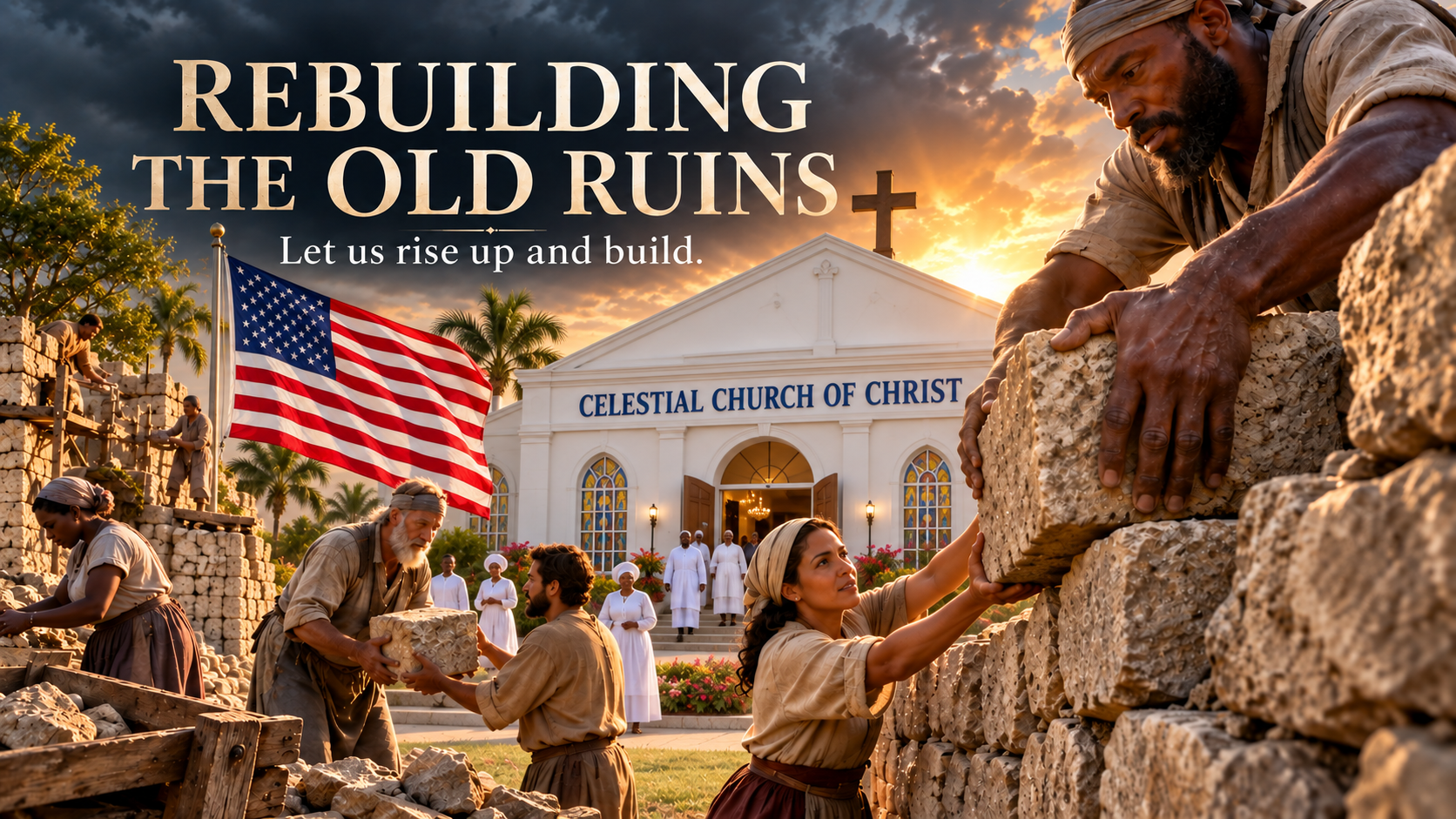
Nehemiah refused to debate his critics. Instead, he prayed and set a vigilant watch (Nehemiah 4:9). He also armed every laborer: “every one with one of his hands wrought in the work, and with the other hand held a weapon… They which builded on the wall… every one with one of his hands wrought in the work, and with the other hand held a weapon” (Nehemiah 4:17-18). Rebuilding in a hostile season requires both a trowel and a sword — the work of restoration and the vigilance to protect it.
He finished what he started. “So the wall was finished in the twenty and fifth day of the month Elul, in fifty and two days” (Nehemiah 6:15). In just fifty-two days, the people rebuilt what had lain broken for over a century. They succeeded because they worked with single-minded urgency and faith. God can swiftly restore what the enemy spent decades tearing down. Yet He moves when His people arise with bold conviction.
Living Stones for a Living House
The New Testament elevates this restoration theme to its highest spiritual meaning. Peter explains that believers are “lively stones, [built] up a spiritual house, an holy priesthood, to offer up spiritual sacrifices, acceptable to God by Jesus Christ” (1 Peter 2:5). Paul similarly portrays the Church as “built upon the foundation of the apostles and prophets, Jesus Christ himself being the chief corner stone; in whom all the building fitly framed together groweth unto an holy temple in the Lord” (Ephesians 2:20-21). Jude likewise urges us in the last days to continue “building up yourselves on your most holy faith, praying in the Holy Ghost” (Jude 1:20).
This truth reveals the heart of our mission. The essential ruin we must rebuild is not stone and mortar. We must rebuild the human heart, the family altar, and the purity of the local church. Our Lord Jesus Christ is the ultimate Rebuilder. Regarding His own body, the truest temple, He declared: “Destroy this temple, and in three days I will raise it up” (John 2:19). Every faithful restoration work mirrors His resurrection power. God can rebuild what satan damages, making it far more glorious: “The glory of this latter house shall be greater than of the former” (Haggai 2:9).
The Urgency Cannot Be Overstated
We stand at a critical Nehemiah moment. The reports around us are clear: distressed families, weary assemblies, and spiritual affliction. We do not need to debate whether the ruins exist. The real question is whether we will weep, pray, and then boldly declare: “Let us rise up and build.” Every day of passive delay allows the enemy to deepen the devastation.
Malachi concludes the Old Testament with both a promise and a solemn warning. The Lord promised to send Elijah “to turn the heart of the fathers to the children, and the heart of the children to their fathers, lest I come and smite the earth with a curse” (Malachi 4:6). Rebuilding is not a casual luxury in the Christian walk. It is the divine remedy against ruin. We must choose between active restoration or ongoing collapse.
Let us take hold of the promise in 2 Chronicles 7:14: “If my people, which are called by my name, shall humble themselves, and pray, and seek my face, and turn from their wicked ways; then will I hear from heaven, and will forgive their sin, and will heal their land.” Healing for our land starts with humility among God’s people. Rebuilding the outer walls starts with rebuilding our inner devotion.
The center does not have to collapse. However, it will not hold on its own. God is calling faithful servants to stand in the gap. He seeks those who will look upon the broken walls and declare: “Come, and let us build up the wall of Jerusalem, that we be no more a reproach” (Nehemiah 2:17). May the Lord find us courageous, watchful, and dedicated to rebuilding the old ruins for His glory.
Arise. Build. Before the ruin spreads further.
💬 Questions or need prayer? We are here any time:
- ☎️ 1-844-7-CCC-HUB (844-722-2482) – Toll-free: call free - ask Grace (LULI) any question, or ask her for prayer and our Prayer Minister or Comfort will pray with you right on the call. Text JOIN for service and event updates (Call · Text JOIN)
- 📱 959-CCC-CHUB (959-222-2482) – Call - ask Grace (LULI) any question, or ask her for prayer and our Prayer Minister or Comfort will pray with you right on the call - or chat with Grace on WhatsApp (Call · WhatsApp)
- 💬 +1 771-233-5885 – Chat with Grace (LULI) on WhatsApp: questions, prayer requests and more (WhatsApp)