





As we celebrate our heroes this month, we remember the names we know well, and also the people who appear in our history for only a moment. Sometimes one moment, handled with wisdom, deserves to be remembered for generations.
Thank you for reading this post, don't forget to subscribe!One such person is a police officer in Porto Novo. We do not know his name. We know what he did because Papa Oshoffa told the story himself.
On Wednesday, 18 January 1969, at the Makoko headquarters church in Lagos, the Reverend Pastor Prophet Founder Samuel Bilehou Joseph Oshoffa gave the history of the Celestial Church of Christ in place of the evening sermon. That account, in his own words, is preserved in the Church’s Constitution (Nigeria Diocese, 1980). Paragraphs 27 to 30 tell of the officer.
Thirteen days without sleep
It was the autumn of 1947, in the weeks after the vision of 29 September. News of what was happening in Papa Oshoffa’s house had spread across Porto Novo. Some people were curious. Others were hostile: there was gossip that he had “bought magic,” and the Methodist Church, in his words, was “shaken to its foundations.”
His house was full: Muslims, Catholics, Methodists and followers of traditional religion, about two hundred people. For thirteen days he could not sleep.
Here the history shows us a human being. The man at the centre of these events was exhausted. Years later he would admit that he did not yet understand what was happening to him; the proof, he said, was that he had asked the police to send the crowds away (paragraph 31).
“He had no right”
On a Friday, Papa Oshoffa sent word through Dominic Adande to the expatriate police officer in charge of the town. He reminded the officer that he was known in Porto Novo as a music player, and he asked for policemen to come and drive the people out of his house.
Dominic confirmed that Oshoffa was a citizen of the town, and the officer asked to see him. Papa Oshoffa went and told him the whole story.
He replied that he had no right to send police officers to drive people out.
— Papa Oshoffa, history of the Church, Makoko, 18 January 1969
CCC Constitution (Nigeria Diocese), paragraph 27
The officer refused. His own father was a Christian, he explained, and he did not have the power to drive anybody away.
Then he went further. He suspected, he said, that God wished to use Oshoffa for a certain purpose. Instead of breaking up the gathering, Oshoffa should hold an open-air meeting the following Saturday, invite people with notices to offices and other publicity, and let them come. He said he would be there himself.
“Thoroughly fed up”
Papa Oshoffa did not welcome the advice. He tells us honestly that the reply left him “thoroughly fed up with the whole situation.”
But the people with him agreed with the officer at once. Those who could read and write prepared notices and carried them all over Porto Novo.
The open-air meeting
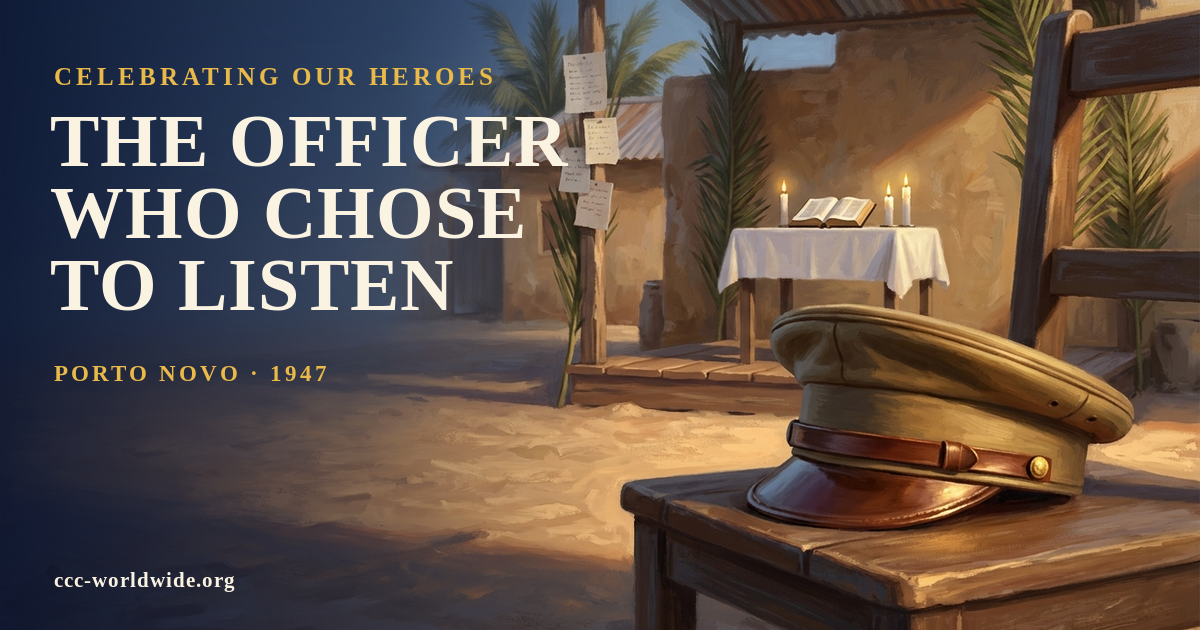
People who had only heard rumours came to see for themselves. A wooden dais was built. Papa Oshoffa sat on it with a prophet on either side of him, a Bible open before him (he was guided not to read it) and three candles lit.
The questions came from every side. Alex Aganyimi, a Togolese member of the Cherubim and Seraphim Church, asked why people should accept him after Moses Orimolade. A Catholic asked about the authority given to St Peter and St Paul. Papa Oshoffa answered each one as the answers were given to him.
They left that day glorifying God. Many more people began to join him. And Papa Oshoffa’s own conclusion is this:
That marked the beginning of the Church and its growth.
— Papa Oshoffa
CCC Constitution (Nigeria Diocese), paragraph 30
Why he is a hero
A frightened or careless officer had an easy option: send the police, clear the house and close the matter. This one chose to listen first.
- He listened before he acted.
- He refused to use his office to drive the crowd away.
- He recognised a purpose that Papa Oshoffa himself was still trying to understand.
- He turned a request to scatter people into a plan to gather them.
The Constitution does not call him a member, a founder or a supporter of the Church, and we should not either. We do not know whether he attended the meeting. His place in the story is small and specific, and it matters.
God works through unexpected people
CCC Hymn 526: “The way of God are mysterious”
Papa Oshoffa asked for the crowd to be sent away. A foreign police officer, whose name the history did not keep, told him to invite more. A believer may see the hand of God in that: the counsel that opened the way came from outside the Church, from a man who was asked to use force and chose not to.
This does not make Papa Oshoffa’s calling smaller. It shows that a divine calling unfolds in a real human life, with tiredness, doubt, and moments when someone else’s advice becomes the next step.
A lesson for anyone in authority
Authority gives a person the power to shape other people’s lives. This officer used his well: he listened, he refused to do harm, and he offered a better way. Leaders in churches, families, workplaces and public service can learn from him. Our answer at a hard moment may matter far beyond what we can see.
Honouring the people at the edges of the story
In this one episode, Dominic Adande carried the message, the officer gave the counsel, and the literate companions wrote and delivered the notices. Each of them helped bring about the meeting that, in Papa Oshoffa’s words, marked the beginning of the Church.
As we celebrate our heroes, let us remember the officer in Porto Novo, who listened, refused to scatter the crowd, and helped make room for the Celestial Church of Christ to begin.
Source: the history of the Church as told by the Reverend Pastor Prophet Founder S. B. J. Oshoffa at Makoko on 18 January 1969, in the Constitution of the Celestial Church of Christ (Nigeria Diocese, 1980), paragraphs 10 and 27–31. Calling the officer a “hero” and the reflections on providence are our interpretation of the events he described. The picture is an illustration: no photograph of the officer is known.
#CelestialChurchOfChrist #CelebratingOurHeroes #UnsungHeroes #ChurchHistory #FaithAndLeadership
@followers #followerseveryone #followmeonfacebook #follower #followformore #followersreels #followforfollowback
💬 Questions or need prayer? We are here any time:
- ☎️ 1-844-7-CCC-HUB (844-722-2482) – Toll-free: call free - ask Grace (LULI) any question, or ask her for prayer and our Prayer Minister or Comfort will pray with you right on the call. Text JOIN for service and event updates (Call · Text JOIN)
- 📱 959-CCC-CHUB (959-222-2482) – Call - ask Grace (LULI) any question, or ask her for prayer and our Prayer Minister or Comfort will pray with you right on the call - or chat with Grace on WhatsApp (Call · WhatsApp)
- 💬 +1 771-233-5885 – Chat with Grace (LULI) on WhatsApp: questions, prayer requests and more (WhatsApp)
Do you know more about this story?
Perhaps an elder in your parish told you about the early days in Porto Novo. Join the CCC Worldwide Community and share what you know in the comments below. Joining is free.
Join and comment Already a member? Log in