




Celebrating Our Heroes and Heroines
The Celestial Church of Christ was established through the calling and anointing of God upon the Pastor Founder, Prophet Rev. Pastor Samuel Bilehou Joseph Oshoffa, and through the contributions of several people whom God used in different ways during the Church’s formation and early growth.
Thank you for reading this post, don't forget to subscribe!Throughout this month of celebrating our heroes and heroines, we are remembering those contributions with gratitude. We have reflected on people who offered counsel, received spiritual revelations, carried invitations, accompanied the mission, and helped the Church reach new communities.
Today, we remember Marrie and Frederic Zevenu, a husband and wife whose experiences and actions appear in the constitutional account of the Church’s beginnings.
Their story invites us to consider the importance of bearing witness and communicating faithfully.
Marrie’s experience during the founding encounter
On 29 September 1947, the day of the Divine Order, Papa Oshoffa was praying in his house with some visiting friends. Paragraph 25 records Marrie, the wife of Frederic Zevenu, among those present. Immediately after the Founder received the divine message, she exclaimed that she saw Jesus. (CCC Constitution, paragraphs 24–25)
She said Jesus then displayed His sides and she could see where He had been speared and that Jesus came down from the cross, stood before him (Pastor) and took him (Pastor) into a room. When they both re-emerged, the woman continued, he (Pastor) was dressed in a white tunic full of stars … I also related to her what I had seen and heard.
— Papa Oshoffa, Makoko, 18 January 1969
CCC Constitution (Nigeria Diocese, 1980), paragraph 25
Within the Church’s account, her testimony forms part of the remembrance of that encounter.
For devotional reflection, it encourages us to appreciate the people who listen, observe, and speak carefully about what they have experienced.
Frederic carried the account into the community
Paragraph 26 describes Frederic Zevenu, identified as a Roman Catholic, meeting a group of young people playing ayo in the Jogrey quarter of Porto Novo at ten o’clock the next morning, and telling them about the previous day’s events. About twelve of them ran to the Founder’s house. The account says that seven received spiritual messages about the tenets of the Church, while the other five went back to spread the news, and those who heard them came too. (CCC Constitution, paragraph 26)
This places Frederic within the sequence through which more people became aware of what was happening.
A conversation can matter
Their story gives us an opportunity to reflect on the effect of ordinary conversations.
Much of community life happens through people speaking to one another. An experience is shared. Someone asks a question. Another person decides to visit and learn more.
We cannot always foresee where a conversation will lead. We can take responsibility for the care with which we speak.
Do we communicate accurately?
Do we distinguish what we witnessed from what someone else told us?
Are we willing to acknowledge what we do not understand?
These questions matter whenever we share spiritual experiences, family memories, or accounts of the Church’s history.
Witness carries responsibility
Our heroes-and-heroines series depends on testimony preserved for later generations.
That should make us thoughtful about the stories we pass on.
A sincere account deserves careful listening. It also deserves faithful retelling. Adding dramatic details can change the meaning of a story and make it harder for others to understand what was originally recorded.
Marrie and Frederic’s place in the founding narrative invites us to value honesty in remembrance.
When teaching our children, speaking in our parishes, or publishing a post, we should make clear where our information comes from. Where details are uncertain, we can leave that uncertainty visible.
Careful communication is a service to those who come after us.
Remembering a husband and wife
This reflection also gives us a reason to consider households within the life of a spiritual community.
Family members may experience an event differently. They may remember different details, ask different questions, and contribute in different ways.
Listening within a household can help preserve those experiences. It can create space for reflection, prayer, and understanding.
For families today, there is value in making time to talk about faith respectfully. Children should be able to ask questions. Adults should be willing to listen. Memories should be shared with patience and care.
Such conversations can become part of what one generation entrusts to another.
Giving each person their place
Marrie and Frederic appear in the same part of the constitutional narrative, but each has a distinct contribution.
Remembering both allows us to give attention to the woman who related her experience and the man who carried the account to others.
This is part of the purpose of our celebration: looking closely enough to recognise the people within the larger story.
Some names appear briefly. Their brief appearance can still give us something meaningful to remember.
Our hero and heroine deserve remembrance
Today, we honour Marrie and Frederic Zevenu, whose household holds a place in the constitutional account of the Church’s beginnings.
May their story encourage us to listen carefully, communicate truthfully, and preserve our shared history responsibly.
As this series continues, we will remember other heroes and heroines whose different contributions deserve our gratitude.
Let us also consider the stories we are creating through our own conduct. May the words we speak and the service we offer leave something worthwhile for those who follow us.
We remember the people. We honour their contributions. We give the glory to God.
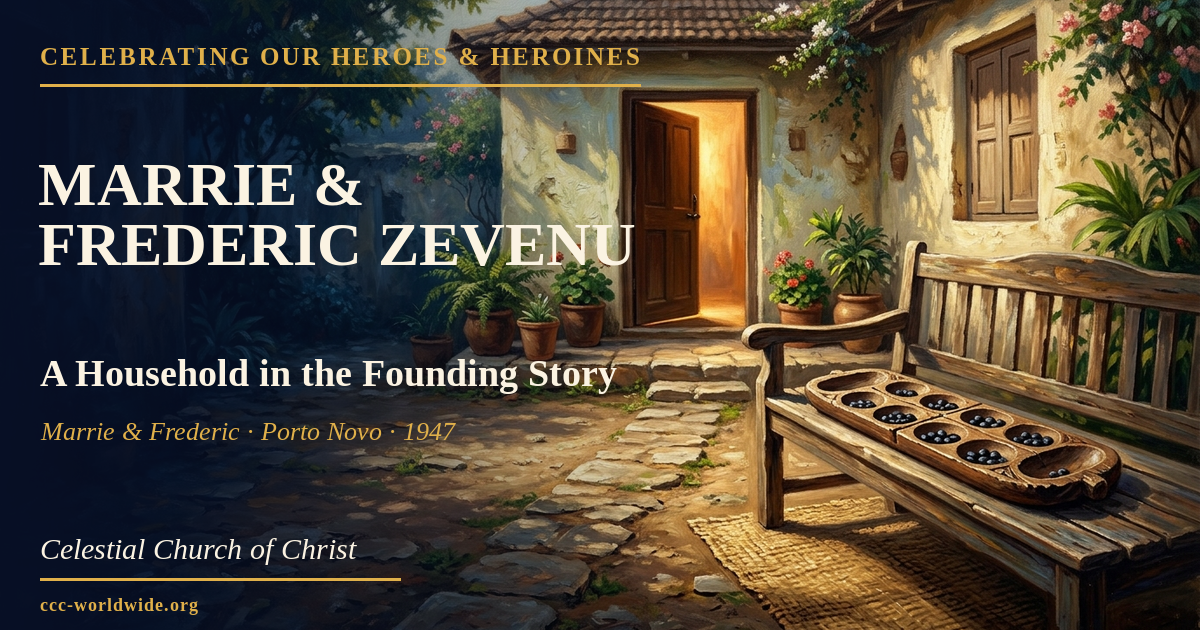
Historical basis: Constitution of the Celestial Church of Christ (Nigeria Diocese, 1980), foundation history told by Papa Oshoffa at Makoko on 18 January 1969, paragraphs 24–26. Names appear with spelling variations in reproduced editions. Reflections on testimony, family, and communication are devotional applications of the account. The picture is an illustration: no photograph of them is used.
#CelestialChurchOfChrist #MarrieZevenu #FredericZevenu #CelebratingOurHeroes #HeroesAndHeroines #ChurchHistory #FaithAndService
@followers #followerseveryone #followmeonfacebook #follower #followformore #followersreels #followforfollowback
💬 Questions or need prayer? We are here any time:
- ☎️ 1-844-7-CCC-HUB (844-722-2482) – Toll-free: call free - ask Grace (LULI) any question, or ask her for prayer and our Prayer Minister or Comfort will pray with you right on the call. Text JOIN for service and event updates (Call · Text JOIN)
- 📱 959-CCC-CHUB (959-222-2482) – Call - ask Grace (LULI) any question, or ask her for prayer and our Prayer Minister or Comfort will pray with you right on the call - or chat with Grace on WhatsApp (Call · WhatsApp)
- 💬 +1 771-233-5885 – Chat with Grace (LULI) on WhatsApp: questions, prayer requests and more (WhatsApp)



Do you know more about Marrie and Frederic Zevenu?
Perhaps an elder in your parish, in Porto Novo or elsewhere, has told you about this household or about the first days of the Church. Join the CCC Worldwide Community and share what you know in the comments below. Joining is free.
Join and comment Already a member? Log in