





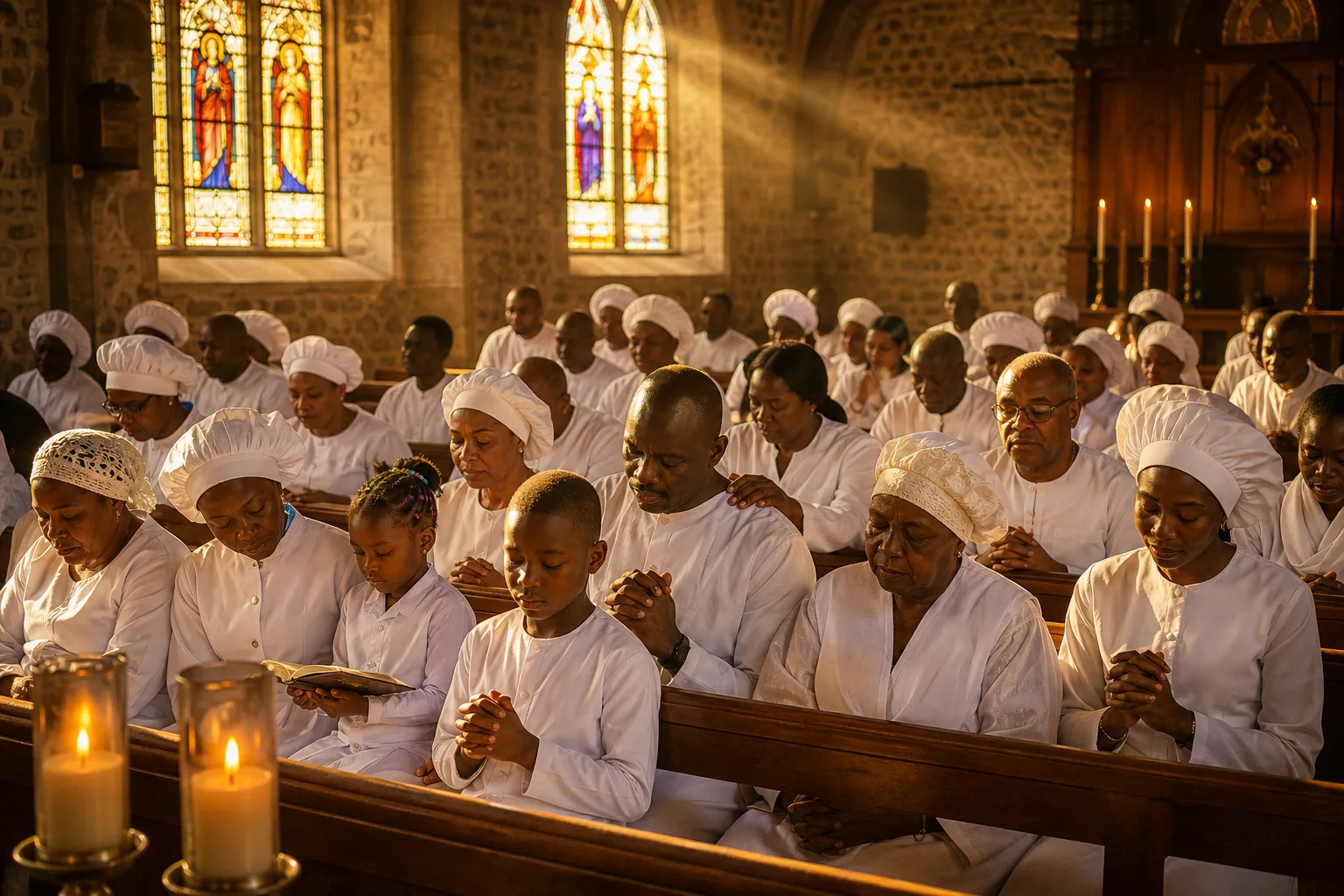

How Does Church Community Strengthen Faith?
A believer sitting alone with a Bible, wrestling with doubt, struggling through a season of spiritual dryness—this scene is not uncommon. Yet it reflects a modern misunderstanding about faith formation. The truth that Scripture and centuries of Christian witness affirm is simple and profound: faith is not meant to flourish in isolation. How does church community strengthen faith? Through shared worship, mutual accountability, collective intercession, and the daily witness of believers living out their convictions together.
Thank you for reading this post, don't forget to subscribe!When you join a church community like the Celestial Church of Christ Worldwide, you step into something far larger than a weekly gathering. You enter a network of spiritual relationships designed by God Himself to deepen, refine, and anchor your personal faith. This article explores the theological foundations and practical mechanisms through which church fellowship strengthens belief, and provides concrete steps to leverage that strength in your own spiritual journey.
The Biblical Foundation for Community-Based Faith
The New Testament consistently presents faith not as a solitary achievement but as a communal reality. The Apostle Paul writes in 1 Corinthians 12:12-13: “For as the body is one, and hath many members, and all the members of that one body, being many, are one body: so also is Christ. For by one Spirit are we all baptized into one body, whether Jews or Gentiles, whether bond or free; and have been all made to drink into one Spirit” (KJV).
This metaphor of the body of Christ is not decorative language. It describes a functional reality: you need other believers, and they need you. Your faith is strengthened through the eyes, hands, ears, and hearts of your church family. When one member grows, the whole body is edified. When one member suffers, the entire community bears witness and responds with love.
The writer of Hebrews reinforces this urgency in Hebrews 10:24-25: “And let us consider one another to provoke unto love and to good works: Not forsaking the assembling of ourselves together, as the manner of some is; but exhorting one another: and so much the more, as ye see the day approaching” (KJV).
Notice the verb “provoke”—the Greek word paroxysm means to stir up or stimulate. Your church community is meant to actively provoke you toward love and good works. This is not gentle suggestion; it is intentional spiritual catalysis. Regular assembly with believers strengthens your capacity to love and act righteously because you are constantly exposed to living examples of faith in action.
Shared Worship as a Foundation for Deeper Faith
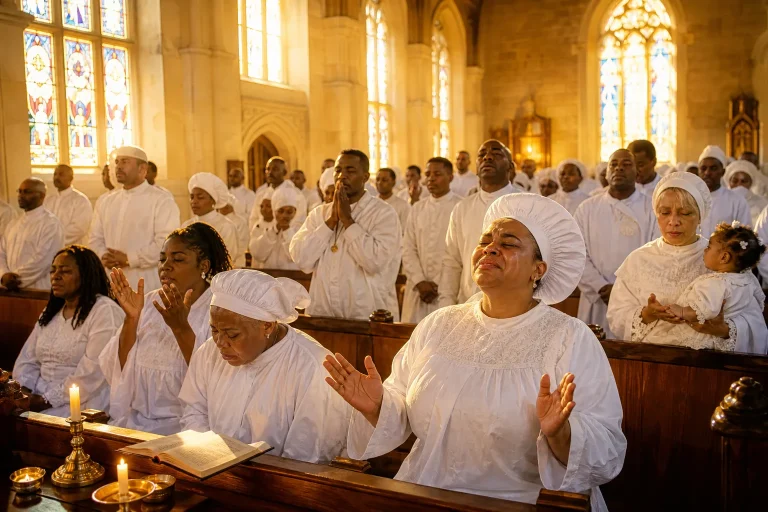
One of the most direct ways that church community strengthens faith is through shared worship. When you worship alone, your prayer and praise are real and valid. But when hundreds of voices lift the same hymns, when the entire assembly bows in unison, when the Spirit moves through a gathered people—something transcendent happens.
Shared worship creates what scholars call “emotional contagion” in a redemptive sense. Your faith is lifted by the faith of others. Your doubt is steadied by the conviction of your brothers and sisters. A person who arrives at church struggling with discouragement may leave transformed, not because the pastor said anything magical, but because they felt the presence of God through the genuine devotion of the community.
In the Celestial Church of Christ tradition, worship is characterized by deep reverence, vibrant prayer, and the expectation that the Holy Spirit will move in tangible ways. This creates an atmosphere where individual faith is both expressed and elevated. When you sing a hymn of trust during a season of uncertainty, surrounded by voices affirming the same truth, your own belief in God’s faithfulness deepens through the act itself.
Psychologically and spiritually, this is sound. Our brains are wired for social reinforcement. Our spirits respond to collective affirmation of truth. The early church understood this so thoroughly that they prioritized gathering, often at personal risk, because they knew that scattered believers would weaken while assembled believers would strengthen.
Accountability as a Mirror for Genuine Faith
One of the most underappreciated ways that church community strengthens faith is through accountability. This does not mean harsh judgment or legalistic policing. Rather, it means having people in your life who know you well enough to ask hard questions: Is your faith translating into action? Are you growing in holiness? Are you resisting temptation? Are you serving others?
The Apostle James writes, “Therefore confess your sins to each other and pray for each other so that you may be healed” (James 5:16, NIV). Confession and accountability within the body of Christ are not optional add-ons; they are mechanisms of spiritual healing.
When you belong to a faith community with genuine accountability structures, your faith is tested and refined. You cannot simply profess belief on Sunday and live in contradiction the rest of the week while remaining unnoticed. The community sees your life. And when they see inconsistency, a healthy community responds not with judgment but with loving confrontation aimed at restoration.
This process is uncomfortable. It is meant to be. The book of Proverbs repeatedly affirms that iron sharpens iron—that we are refined through honest relationship with others. A community that only affirms and never challenges is not truly strengthening your faith; it is enabling your stagnation. A genuine church community will love you enough to speak truth, which paradoxically deepens your faith by helping you align your profession with your practice.
Collective Intercession and the Power of Corporate Prayer
Another profound mechanism through which church community strengthens faith is collective prayer. When you pray alone, you access God’s throne room directly. When you pray with others, something additional occurs—the power of agreement, the witness of faith being expressed together, the knowledge that you are not alone in your petitions.
Jesus Himself taught this principle in Matthew 18:19-20: “Again I say unto you, That if two of you shall agree on earth as touching any thing that they shall ask, it shall be done for them of my Father which is in heaven. For where two or three are gathered together in my name, there am I in the midst of them” (KJV).
The promise here is not about magical formula; it is about the presence and power of Christ made manifest through unified petition. When your church gathers to pray for a member facing illness, job loss, or family crisis, something shifts spiritually. The person being prayed for feels known and loved. The people praying experience their own faith deepened by participating in intercession. The entire community’s confidence in God’s care is reinforced.
Many believers report that their faith was sustained during dark seasons not by individual Bible reading alone but by the prayers of their church community. They felt held up by invisible hands. They sensed that others believed on their behalf when their own faith wavered. This is not superstition; this is the normal operation of the body of Christ as Scripture describes it.
Mentorship and the Transfer of Faith Across Generations
A church community also strengthens faith through mentorship and the intergenerational transmission of belief. Young believers need to see mature faith embodied in real people. New Christians need guides who have walked the path longer. Parents need the wisdom of older parents. Leaders need accountability from peers who have navigated similar challenges.
The apostle Paul regularly mentioned his spiritual mentors and also spoke of his role in mentoring others. He wrote to Timothy, “And the things that thou hast heard of me among many witnesses, the same commit thou to faithful men, who shall be able to teach others also” (2 Timothy 2:2, KJV). Faith is meant to be passed down through personal relationship and modeling, not merely through books or sermons.
In a church community, this happens naturally. A young mother watches an older woman navigate hardship with grace and learns that faith is not about avoiding suffering but about maintaining trust through it. A teenager witnesses a businessman live with radical integrity in his workplace and realizes that faith has practical implications beyond Sunday. A new believer sees a longtime member repent and grow and learns that maturity in Christ is a lifelong process of transformation.
This mentorship function cannot be replicated by technology or distance. It requires presence, time, and the willingness to let others see your struggles alongside your victories. A healthy church community provides this context naturally through small groups, discipleship programs, and the informal relationships that develop when believers gather regularly.
The Practice of Shared Struggle and Collective Healing
Faith is not always joyful. Sometimes it is wrestling with doubt, processing grief, or enduring prolonged disappointment. A church community strengthens faith precisely by creating space for this honest struggle.
When you suffer alone, suffering can crush faith. The questions become consuming: Where is God? Why hasn’t He answered? Does He care? But when you suffer within a community of believers who have weathered their own storms, something shifts. You see examples of persisting faith. You hear testimonies of God’s provision after long waiting. You receive comfort that is real because it comes from people who understand the depth of pain.
The community features of the Celestial Church specifically create space for this kind of honest, faith-building struggle. Through prayer circles, pastoral care, and small group fellowship, believers are not left to process their pain alone. The community witnesses their struggle, prays for their breakthrough, and celebrates their restoration—and this collective journey deepens everyone’s faith.
Paul wrote about this in 2 Corinthians 1:3-4: “Blessed be God, even the Father of our Lord Jesus Christ, the Father of mercies, and the God of all comfort; Who comforteth us in all our tribulation, that we may be able to comfort them which are in any trouble, by the comfort wherewith we ourselves are comforted of God” (KJV). The pain you experience is not wasted; it equips you to strengthen others. This reciprocal strengthening through shared struggle is one of the most powerful faith-builders available to the Christian.
Collective Mission and Shared Kingdom Purpose
Faith also grows stronger when it is directed toward a common purpose. A church community strengthens individual faith by gathering it into a collective mission of worship, service, and proclamation.
When you serve alongside other believers—whether visiting the sick, feeding the hungry, discipling new converts, or reaching out to your neighborhood—your faith is activated. Belief that remains theoretical remains weak. But belief that is deployed in service, that is tested in encounter with real human need, that is refined through the challenges of actually living out the Gospel—this faith becomes robust and real.
Your church community provides both accountability and encouragement for this missional faith. You do not have to figure out alone how to live out your convictions. The community has developed practices, wisdom, and structures that help translate faith into action. Young believers learn how to evangelize by witnessing mature believers do it. New members discover their spiritual gifts through serving alongside others who recognize potential they had not yet seen in themselves.
A Practical Action Plan: Leveraging Church Community to Strengthen Your Faith
Understanding how church community strengthens faith is one thing. Actually building those relationships and structures is another. Here is a concrete plan for deepening your faith through your church community:
Step One: Commit to Regular Corporate Worship
This is non-negotiable. You cannot benefit from community if you are absent from it. Commit to attending worship services consistently, not just when circumstances are convenient. This regularity builds relationship, exposes you to sustained teaching, and connects you to the rhythms of your church’s prayer and praise life.
Step Two: Join a Small Group
Visit your church’s website or speak with a pastor about joining a small group or ministry team. Small groups are where the real intimacy of Christian community develops. Choose a group aligned with your life stage or interests—a young adults group, parents group, Bible study, or prayer circle. Commit to attending regularly and opening up honestly about your faith journey.
Step Three: Find or Become an Accountability Partner
Ask someone more mature in faith than you (or a peer at a similar stage) to be your accountability partner. Meet monthly or quarterly to discuss your spiritual goals, challenges, and progress. Be vulnerable. Ask hard questions. Listen without defensiveness when they speak truth to you. This relationship will be one of the most faith-strengthening you develop.
Step Four: Engage in Corporate Bible Study
While personal Bible study is vital, studying Scripture with others adds richness and depth. You see passages through others’ eyes. You learn from their insights and questions. You discover how Scripture speaks to situations you may not have faced personally but others in your group have. Participate actively in your church’s Bible studies, not as a passive learner but as someone who contributes questions and observations.
Step Five: Commit to a Season of Serving Together
Volunteer for a ministry—children’s education, hospitality, outreach, worship leadership, or any area where your gifts align. Serving alongside others creates bonds that deepen faith. You will work through challenges together, celebrate victories together, and grow in your understanding of God’s kingdom together.
Step Six: Participate in Prayer
Attend your church’s prayer meetings. Add your voice to the collective intercession. Pray for other members’ needs. Request prayer for yourself. This simple participation in corporate prayer will transform how you experience both your faith and your church community.
Addressing Common Obstacles to Community-Based Faith
Some people resist church community for genuine reasons. It is worth addressing these directly.
Fear of judgment: Many have been hurt by churches that were harsh, legalistic, or hypocritical. A genuine community of faith acknowledges weakness, extends grace, and pursues restoration rather than condemnation. If you have been hurt by a church, that grief is valid. But recognize that the problem was the church’s failure to live out biblical community, not the concept of community itself. Seek out a church—like the Celestial Church of Christ Worldwide—where grace is central and truth is spoken in love.
Introversion or social anxiety: Not everyone is naturally outgoing. A healthy church community should have spaces for quieter souls—smaller groups, one-on-one mentoring, behind-the-scenes service roles. You do not have to be extroverted to benefit from and contribute to community.
Busyness: Modern life is relentless. But consider this: you will always have another priority if you do not make church community a non-negotiable commitment. Even one small group meeting per month is a beginning. Even attending worship when you can is an entry point. Start somewhere and build gradually.
Past religious trauma: Some people have experienced abuse within religious contexts. If this is you, healing may require professional support alongside spiritual restoration. A compassionate church community can be part of your healing, but it will not be the whole solution, and that is okay. Move slowly, test whether you feel safe, and do not shame yourself for needing time.
The Witness of the Global CCC Community
The Celestial Church of Christ exists worldwide, with believers across continents united by faith in Christ, commitment to Scripture, and the conviction that the Holy Spirit moves in power today. This global community is a living demonstration of how church fellowship strengthens faith across cultural boundaries, languages, and circumstances.
Members report that their faith deepens not only through local church participation but through knowing they are part of a worldwide body of believers. When one member across the globe is lifted up in prayer, all members sense their connection to that intercession. When a testimony of God’s faithfulness is shared from a church in a different continent, your own faith is encouraged because you see evidence of God’s faithfulness transcending geography and culture.
This global dimension of Christian community is particularly powerful in our fragmented age. It reminds us that our faith is not parochial or limited but part of a story that spans continents and centuries. You are not alone in your struggle or your joy. Millions of believers worldwide are walking the same path, calling on the same God, and experiencing His faithfulness in real time.
The Role of Transparency and Authenticity
For a church community to truly strengthen faith, it must be characterized by authenticity. This means leaders being willing to admit struggles and mistakes. It means members not projecting a false image of spiritual perfection. It means sermons that grapple with hard questions rather than offering shallow comfort.
When leaders are transparent about their own faith journey—their doubts, their failures, their ongoing repentance and growth—permission is given to the entire community to be honest. Members feel less pressure to pretend they have arrived. They are more likely to ask for help, admit when they are struggling, and extend grace to others who are struggling.
This authenticity is what transforms a church from a gathering of people pretending to be fine into a genuine community of wounded healers, weak people dependent on a strong God, sinners who have experienced mercy and who extend it to others.
Practical Frequently Asked Questions
Why Is Church Community Important for Spiritual Growth?
Church community is important for spiritual growth because faith was designed by God to develop within relationships. Scripture consistently presents believers as members of a body, not as isolated individuals. Within community, your growth is accelerated by exposure to mature faith, challenged by accountability, supported through prayer, and motivated by common mission. Growth that might take a believer a decade in isolation often develops in three years within an engaged church community. Additionally, community provides correction when you drift, encouragement when you struggle, and celebration when you grow—all essential components of transformation.
How Does Accountability in a Faith Community Strengthen Belief?
Accountability strengthens belief by creating a reality check. When you know others are aware of your commitments and will ask how you are doing with them, you are more likely to follow through. This follow-through deepens faith because faith is a practice, not merely a feeling. As you practice living out your convictions—sharing your faith, serving others, resisting temptation, forgiving—your belief is reinforced by your own experience. Additionally, when accountability partners lovingly confront you about inconsistency between profession and practice, this correction, though uncomfortable, ultimately strengthens your faith by aligning your whole life with your stated beliefs.
What Role Does Shared Worship Play in Deepening Faith?
Shared worship deepens faith by connecting you emotionally, spiritually, and corporately to truth you profess. When you sing hymns of trust with hundreds of other voices, when you bow in prayer together, when you hear Scripture proclaimed to a gathered people, you experience truth not as abstract concept but as lived reality. The faith of others becomes contagious in a redemptive sense. Your doubt is calmed by the conviction of your brothers and sisters. Your praise is elevated by collective adoration. Your understanding of God deepens as you hear others testify to His faithfulness and see others responding to Him with reverence and love. Over time, regular participation in authentic shared worship transforms how you experience God and understand your place in His kingdom.
Conclusion: How Church Community Strengthens Faith Long-Term
The question you came with—how church community strengthens faith—has a clear answer rooted in Scripture and confirmed by countless testimonies: it strengthens faith by surrounding your individual belief with a network of shared conviction, mutual accountability, collective prayer, and common mission. It strengthens faith by exposing you to mature examples of faith lived over decades. It strengthens faith by creating space for honest struggle without isolation. It strengthens faith by translating belief into action within a context of support and correction.
If you are isolated in your faith right now, the most practical step you can take today is to visit a church community. If you are attending services but not deeply connected, the next step is to join a small group or ministry team. If you are already engaged in community, the invitation is to go deeper—to be more vulnerable, more honest, more committed to the growth of others alongside your own.
The Celestial Church of Christ Worldwide exists to provide exactly this kind of community. Through local congregations, online fellowship, prayer circles, Bible study groups, and the wider communion of believers across the globe, the CCC creates environments where individual faith is strengthened through collective devotion. If you are not yet part of such a community, you are invited to join us. If you are already a member, the invitation is to deepen your participation and commitment to this life-giving community.
Your faith was never meant to be a solitary project. It was meant to grow, be tested, be strengthened, and mature within the loving, honest, prayerful community of God’s people. That community awaits you.
A Closing Prayer: “Lord, I thank You for the gift of Your church, the body of Christ. Strengthen my faith through genuine relationships with believers who love You and who love me. Give me courage to be vulnerable, honesty to live authentically, and humility to receive correction and offer grace. Help me to find or build a community where faith is deepened through shared worship, where truth is spoken in love, where prayer binds us together, and where mission unites our hearts. And as my faith is strengthened, help me to strengthen others. In the name of Christ, Amen.”
Trusted Resources for Further Study
For deeper study see BibleGateway, Bible.com, Britannica, WHO, and Library of Congress.
💬 Questions or need prayer? We are here any time:
- ☎️ 1-844-7-CCC-HUB (844-722-2482) – Toll-free: call free - ask Grace (LULI) any question, or ask her for prayer and our Prayer Minister or Comfort will pray with you right on the call. Text JOIN for service and event updates (Call · Text JOIN)
- 📱 959-CCC-CHUB (959-222-2482) – Call - ask Grace (LULI) any question, or ask her for prayer and our Prayer Minister or Comfort will pray with you right on the call - or chat with Grace on WhatsApp (Call · WhatsApp)
- 💬 +1 771-233-5885 – Chat with Grace (LULI) on WhatsApp: questions, prayer requests and more (WhatsApp)