





Celebrating Our Heroes and Heroines
This month we are remembering the people God placed around the Reverend Pastor Prophet Founder, Samuel Bilehou Joseph Oshoffa, as the Celestial Church of Christ was born and began to grow. We have remembered a police officer in Porto Novo who chose to listen, and Alexander Yanga, through whom the Church’s name was revealed.
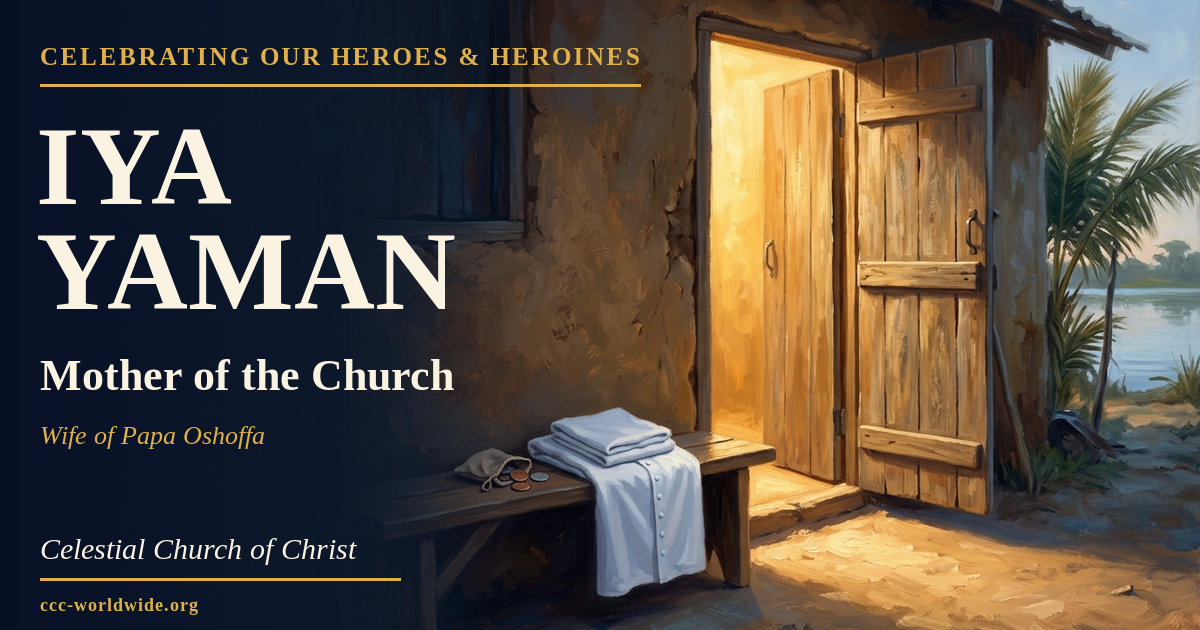
Thank you for reading this post, don't forget to subscribe!Today we honour the woman remembered as the Mother of the Church: Iya Yaman (Felicia Yaman Oshoffa), the first wife of Papa Oshoffa, and a woman whose own participation is recorded in the history of the early Church.
Her place in this story brings our attention to the family and household within which the founding mission unfolded. As Papa Oshoffa responded to his calling, the people closest to him were also present amid the gatherings, journeys, questions and demands described in the Church’s history.
The woman behind the ministry
Every great work of God has people who stand in the background and hold everything together. For Papa Oshoffa, one of those people was his wife, Iya Yaman.
She took charge of the domestic affairs of the household so that the Pastor could give himself fully to the work God had called him to do. Prayer, healing, travel, and the endless stream of people who came to the house seeking help all depended on a home that was kept in order. Iya Yaman kept it.
She did not have a child for the Pastor. Yet she poured her life into his ministry and sustained it until the end of her days. She had no children of her own, and the Church became her family. That is why we call her Iya, mother: the Mother of the Church.
Elders remember one more thing about her. Every woman in the Church covers her head with the cap, but Iya Yaman was the only woman who never wore the cap. She always covered her head with a scarf instead. Even in how she dressed, she stood apart.
A trusted voice of counsel
Iya Yaman’s part was not only in the home. Researchers who have studied the Church’s early years describe her as a “leading female figure” of that time (Afe Adogame, 1999). Deidre Helen Crumbley, in her book Spirit, Structure, and Flesh (2008), records that she was involved in the formation of the Church, was recognised for her prophetic sayings, and attended the meetings of those early years.
In his doctoral study of the Aladura churches, Timothy Olu Wilson Baiyewu records an elder’s memory that Bada, Yaman and a member in Porto Novo were anointed as full-time workers of the Church. He writes that this “marked the beginning of ranking in the CCC.”
So Iya Yaman was the Founder’s wife and the keeper of his home, and she was also a companion in the mission: a woman whose spiritual insight was valued in the life of the young Church.
At the Founder’s side at Grand-Popo
Papa Oshoffa names her three times in his own account of the Church’s history, which he gave at Makoko on 18 January 1969 and which is preserved in the Church’s Constitution. The first time is in the early years in Dahomey. The sea had overflowed at Grand-Popo and destroyed houses in the town, and the chief sent to Porto Novo, asking Papa Oshoffa to come and pray:
I prepared to go, taking six people with me including Wolida Afose Yanga, his wife Elder Silvestin, Yaman and Leader Mathias from Dannu.
— Papa Oshoffa, Makoko, 18 January 1969
CCC Constitution (Nigeria Diocese, 1980), paragraph 38
At the sea front, Papa Oshoffa did as he was instructed in the Spirit, and the account says that “the sea receded completely.” Iya Yaman was there with her husband, a witness to what God did.
Names of companions in a story like this are easy to pass over. Yet they record the people who were there and shared the journey. Iya Yaman was available. When the mission called the Founder away from home, she went with him. Communities still depend on people who are willing to go when service calls them beyond familiar places.
The day she welcomed the stranger
The best-known moment comes from Makoko, Lagos, in 1954. For three months the prophets had been saying that the Lord Himself would soon visit the Church, and that the members should be ready to recognise Him. On the Friday after that year’s Harvest Thanksgiving, He came, as a blind man.
He first spoke to Christine, another wife in the Founder’s household, and asked her for tobacco, then cigarettes, then kolanuts. She answered that she had none, and finally asked to be left alone, “particularly as the three things He asked are forbidden to Celestians.” Then:
At this point Yaman, who was nearby, intervened and offered Him some money to buy the things He wanted. He declined and blessed her (Yaman) that her purse will never be empty. He then told Yaman to caution her daughter Christine to beware because the world is delicate. He left them.
— Papa Oshoffa, Makoko, 18 January 1969
CCC Constitution (Nigeria Diocese, 1980), paragraph 59
Notice how the Lord spoke to her: He asked Iya Yaman to caution “her daughter.” She was the mother of the household, and even the Lord addressed her that way.
The Lord did not take her money. Instead He blessed her: her purse would never be empty. The one who gave freely received a blessing in return.
Christine was not wrong about the rules. Tobacco, cigarettes and kolanuts are forbidden to Celestians. But Iya Yaman saw something more: a blind stranger in need. She did not argue about what He had asked for. She simply gave.
The stranger left them and walked on toward the other house, some fifty yards away, where Papa Oshoffa was. Papa Oshoffa saw “a sudden beam of light before Him” and recognised at once that He was the Lord whose coming had been foretold. The Lord went into the house with him, blessed water with seven lumps of sugar, and spoke with him about the Church. When Papa Oshoffa offered Him money as alms, He declined: “Mine is not money but Love. May it be so for you as well.”
Iya Yaman’s gift was that kind of love. She gave before she knew who He was.
Scripture says, “Be not forgetful to entertain strangers: for thereby some have entertained angels unawares” (Hebrews 13:2). And Jesus said, “Inasmuch as ye have done it unto one of the least of these my brethren, ye have done it unto me” (Matthew 25:40). That day at Makoko, Iya Yaman lived those words.
The blessing and the responsibility
The Lord gave Iya Yaman two things that morning: a blessing on her purse, and a responsibility to caution Christine. Generosity and guidance came together. An encounter can call us to care for the person in front of us, and also to give thoughtful guidance within our own household or community.
Such guidance needs humility. Correcting another person takes care, patience and a real desire for their good. So we can ask ourselves:
- Do people feel safe approaching us?
- Can we give counsel without humiliating anyone?
- Are we willing to help restore understanding after a difficult exchange?
These are practical questions for family life, parish life and leadership.
A mother who helped others understand
Later in 1954, the Lord appeared again, at the Lagos Bar Beach, while members were being anointed. He spoke to many of them. One lady, Mrs. Adedoyin Adekoya, had come “gorgeously dressed in Yoruba attire,” and the Lord asked her why she had come naked. She was puzzled. Papa Oshoffa records what happened next:
At this juncture, Yaman cut in and pointed out that it was because she was not dressed in her sutana like the others.
— Papa Oshoffa, Makoko, 18 January 1969
CCC Constitution (Nigeria Diocese, 1980), paragraph 70
Like a mother, Iya Yaman understood what the Lord meant and helped a puzzled sister to understand it too. Every Celestian who puts on the white sutana for worship can remember that moment on the beach.
People come to our worship with different levels of knowledge. Some are new, and others have attended for years and still have questions. Those who know our history and practices can follow Iya Yaman’s example and explain with patience, clarity and respect.
What Iya Yaman teaches us
- Quiet service is ministry too. By taking charge of the home, she freed the Pastor for the work of God.
- Women’s wisdom strengthens the Church. Her prophetic insight was valued from the very beginning.
- Faithfulness to the end. She sustained his ministry for the rest of her life.
- Motherhood is bigger than birth. She had no child of her own, yet the whole Church calls her mother.
- Welcome the stranger. When a blind stranger asked for help, she gave before she knew who He was.
So her story turns the question back to us. Who in our parish works quietly in the background so that the ministry can go on? And when someone comes to us poor, unwell or unfamiliar with our ways, do we answer with rules alone, or with kindness first?
There are people in our parishes today who accompany the work, welcome others, teach, advise and care. Let us honour them while they are still with us.
Remembering Iya Yaman
Her relationship to the Pastor Founder belongs in her story, and so do the actions recorded about her. A person does not have to be the central figure in an account to make a contribution worth remembering. When we teach younger generations what a woman like Iya Yaman did, where she appears in the record and why it still matters, we honour her with substance. That is the purpose of this series: to read carefully, remember gratefully and pass on our history responsibly. Our daughters should know that women were present in the history they have inherited, and our sons should learn to recognise and respect that participation.
This month, let us give thanks for Iya Yaman: the wife who stood beside the Founder, the mother who kept his house, and the Mother of the Church who welcomed the stranger at Makoko.
More heroes and heroines are still to come this month.
Today we honour Iya Yaman: wife of the Pastor Founder, Mother of the Church, companion in the early mission, and a woman whose recorded actions invite us to generosity, guidance and understanding.
May our remembrance lead us toward more faithful service in our own generation.
We remember the people. We honour their contributions. We give the glory to God.
Historical source: Constitution of the Celestial Church of Christ (Nigeria Diocese, 1980), Papa Oshoffa’s history given at Makoko on 18 January 1969, paragraphs 38, 58 to 63 and 70 (part 2). The Constitution names her simply as “Yaman.” Her full name and her place as first wife: T. O. W. Baiyewu, The Transformation of Aladura Christianity in Nigeria (PhD dissertation, University of Bayreuth, 2014), p. 155, citing A. Adogame (1999), p. 23, and D. H. Crumbley, Spirit, Structure, and Flesh (University of Wisconsin Press, 2008), p. 61; also O. Olademo, review in AASR Bulletin 31 (2009), p. 31. Her anointing as a full-time worker: Baiyewu, p. 118, from an interview with Titus Olawale Alao (2011). That she ran the Founder’s household, sustained his ministry without children of her own, and wore a scarf rather than the cap is as the Church remembers her. Paragraph 59 is quoted from the original printed edition (page 18), which includes the line about the blessing of her purse. Bible quotations are from the King James Version. The picture is an illustration: no photograph of Iya Yaman is used.
#CelestialChurchOfChrist #IyaYaman #MotherOfTheChurch #CelebratingOurHeroes #HeroesAndHeroines #WomenInChurchHistory #ChurchHistory
@followers #followerseveryone #followmeonfacebook #follower #followformore #followersreels #followforfollowback
💬 Questions or need prayer? We are here any time:
- ☎️ 1-844-7-CCC-HUB (844-722-2482) – Toll-free: call free - ask Grace (LULI) any question, or ask her for prayer and our Prayer Minister or Comfort will pray with you right on the call. Text JOIN for service and event updates (Call · Text JOIN)
- 📱 959-CCC-CHUB (959-222-2482) – Call - ask Grace (LULI) any question, or ask her for prayer and our Prayer Minister or Comfort will pray with you right on the call - or chat with Grace on WhatsApp (Call · WhatsApp)
- 💬 +1 771-233-5885 – Chat with Grace (LULI) on WhatsApp: questions, prayer requests and more (WhatsApp)


Do you remember Iya Yaman?
Perhaps an elder in your parish has told you about her, or about life in the Founder’s household at Makoko. Join the CCC Worldwide Community and share what you know in the comments below. Joining is free.
Join and comment Already a member? Log in