

Celebrating Our Heroes and Heroines
The Celestial Church of Christ was established through the calling and anointing of God upon the Pastor Founder, the Reverend Pastor Prophet Samuel Bilehou Joseph Oshoffa, and through the contributions of several people whom God used in different ways during the Church’s formation and early growth.
Thank you for reading this post, don't forget to subscribe!Throughout this month of celebrating our heroes and heroines, we are remembering those contributions with gratitude. We have reflected on the police officer in Porto Novo, Alexander Yanga and Iya Yaman. Each story has helped us appreciate another person’s place in the history we share.
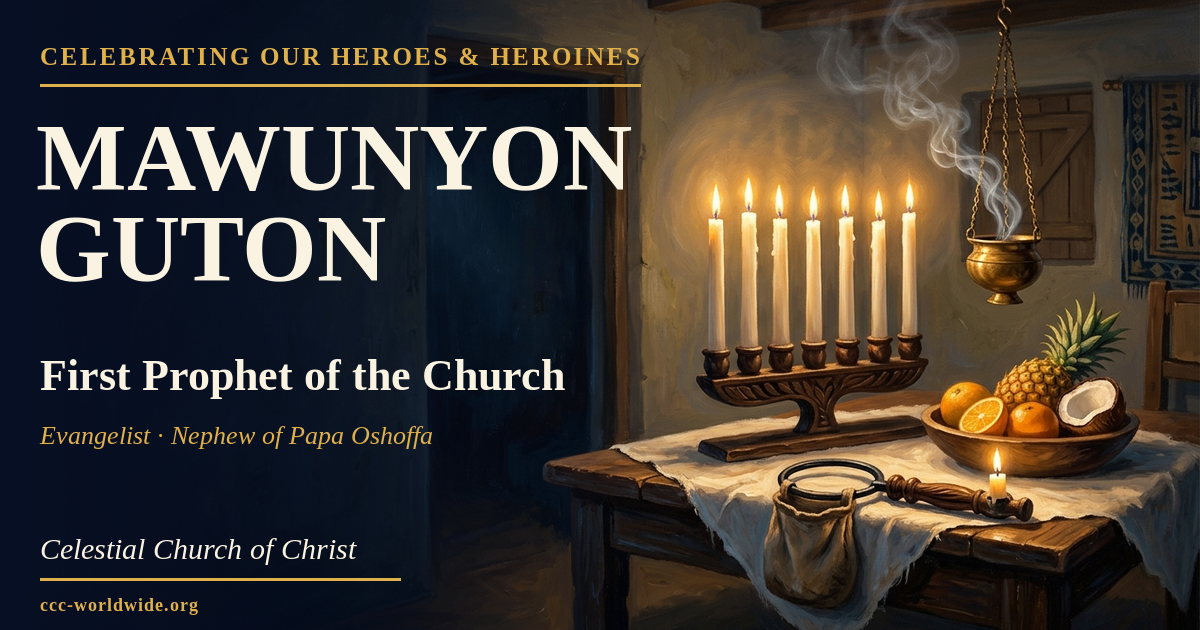
Today we honour Emmanuel Mawunyon Guton, the first prophet of the Celestial Church of Christ, and a person through whom the Constitution records several revelations concerning our worship. Every Celestian who lights the seven candles, sees the collection taken with the Pajaspa, or receives Holy Communion of fruit instead of wine is practising something associated with his name.
His place in the founding story
The Constitution identifies Emmanuel Mawunyon Guton as the only child of the Founder’s elder sister, Elizabeth. In 1947, a few days after Papa Oshoffa returned to Porto Novo from his three months in the forest, word came that Mawunyon had died. Papa Oshoffa recalled what happened next:
What the native doctors failed to do, Christ did: for I touched the deceased, and he came back to life all in the name of Jesus Christ. … Her son, Emmanuel, immediately received the holy gift of prophecy and thus became the first prophet of the Church.
— Papa Oshoffa, Makoko, 18 January 1969
CCC Constitution (Nigeria Diocese, 1980), paragraph 23
His mother left her church and followed her brother. Years later, Papa Oshoffa described his nephew as the one “who later became our Evangelist in Ivory Coast” (paragraph 76).
Within the Church’s testimony, his story is one of life restored and a gift received. From a faith perspective, this invites us to consider what we do with the opportunities God gives us. Gratitude can become service. An experience that changes our lives can also deepen our responsibility towards others.
For us today, the question is personal: how are we using the life, time and gifts entrusted to us?
A contribution preserved in worship
In the first week of October 1947, a few days after the Divine Order of 29 September, the Founder was told that his commission was to found a new Church, starting in his own house. That evening, Papa Oshoffa recalls, Mawunyon “was directed by the Holy Spirit from his father’s house about a mile away to my house.” He arrived singing a song in an unknown language, kneeling, and translated it as he sang: “O praise ye the Lord, all ye heavenly hosts, the great hour is at hand.”
The Founder’s supplement to the history attributes to Mawunyon revelations concerning:
- A heavenly song of praise and its translation (paragraph 79).
- Holy Communion without wine: a mixture of pineapple, oranges and coconut milk (paragraph 80).
- The seven candles: he took a piece of wood and drew the shape of the candleholder (paragraph 81).
- The Pajaspa: the metal-ringed collection pouch with a handle and a socket for a candle that is lit during the collection.
- The call to worship and the Mattah: he saw in heaven a pot of incense being swung, gave the songs that accompany it, and said a box called Mattah should hold the symbol of Christ’s covenant with the Founder, with the altar candles (paragraph 83).
- The watchnight song: a song associated with our Lord’s prayer at Gethsemane, sung at the monthly watchnight service and at the Holy Thursday watchnight (paragraph 88).
Having thus removed our shoes, worn our white sutana or tunic, taken the candles one by one from Mattah … we should wholeheartedly sing … and draw near to God forgetting all about this world. … Mawunyon did not leave that night until about 2.00 am.
— Papa Oshoffa, Ketu, 22 May 1979
CCC Constitution (Nigeria Diocese, 1980), paragraph 83
This gives us a substantial reason to remember him. His name is connected with practices that became part of our shared worship, at a time when the young Church had no building of its own and no order of service.
Learning the history of what we practise
Familiarity can make us stop asking questions. We may know when to stand, when to kneel, what to sing, or where an object belongs, yet know little about the history preserved around it.
Remembering Mawunyon encourages us to become thoughtful learners. When we understand the accounts associated with our worship, we can participate with greater attention and teach younger generations more responsibly. The Founder himself admitted that some of the songs given through Mawunyon “we seem to have forgotten lately.” Remembering him is also a call to keep what was handed down to us.
Parents, teachers, prophets, prophetesses and parish leaders all have a part to play. We can create opportunities for members to ask questions and receive clear explanations. Our history deserves to be read, discussed and understood.
A gift that served the community
Mawunyon’s place in this series also gives us an opportunity to reflect on spiritual gifts. Within the Christian understanding of service, a gift carries responsibility. Its value should be considered in relation to the good it brings to others and the way it directs people towards God.
That calls for humility. A person entrusted with spiritual insight should remain teachable. A person who receives an opportunity to serve should exercise care. Those who speak, explain or guide others should recognise the effect their words can have.
Mawunyon did not keep his gift at home. He answered when the Spirit sent him to the Founder’s house that night, and he later carried the work further, as an Evangelist in Côte d’Ivoire.
As we honour a prophet from the Church’s beginnings, we should also consider the character with which we exercise our own gifts:
- Do we serve patiently?
- Do we speak responsibly?
- Do we welcome correction?
- Do our contributions help the community grow in faith and understanding?
The Founder’s calling and the contributions of others
This series helps us appreciate how different people appear within the Church’s founding history. Honouring their contributions deepens our understanding of the mission entrusted to Papa Oshoffa, and allows us to recognise the people whose participation the account itself preserves.
Mawunyon’s story is especially relevant to the statement with which we began: God worked through several people, with different gifts and contributions, during the formation and early growth of the Church. For believers, that remembrance should encourage gratitude and mutual respect. No one should assume that their own contribution makes everyone else unnecessary. A healthy community makes room for people to serve faithfully and recognises the good they bring.
What we pass to the next generation
When we teach the history of the Church, names should be accompanied by an explanation of why they matter. Our children should be able to ask, “Who was Emmanuel Mawunyon?” and receive an answer grounded in the record.
We should also teach them to distinguish the constitutional account, later recollections and our devotional reflections. Careful teaching honours the people we remember and gives the next generation a sound foundation for learning.
Preserving history is itself a form of service. It requires us to read carefully, acknowledge what we do not know, and resist adding details simply because they make a story more dramatic.
Remembering Emmanuel Mawunyon Guton
Today we honour Emmanuel Mawunyon Guton and give thanks for the contribution associated with his name. The next time the seven candles are lit, the Pajaspa passes along the pews, or the fruit of Holy Communion is shared, let us remember the first prophet of the Celestial Church of Christ.
May his story encourage us to value our shared worship, learn its history and use our gifts with humility.
As this series continues, we will celebrate other heroes and heroines whose contributions deserve remembrance. Each account offers another opportunity to learn, give thanks and consider our responsibilities in the Church today.
We remember the people. We honour their contributions. We give the glory to God.
Historical basis: Constitution of the Celestial Church of Christ (Nigeria Diocese, 1980): Papa Oshoffa’s history given at Makoko on 18 January 1969 (paragraph 23) and his supplement given to the Board of Trustees at Ketu on 22 May 1979 (paragraphs 76, 79 to 83 and 88, part 2). His name appears with spelling variations in reproduced editions (Mawunyon, Mawuyon, Mawunyion), and the Constitution also gives the Yoruba name Olorundara. His years of birth and death are not recorded there. Reflections on gratitude, spiritual gifts and service are devotional applications of the account. The picture is an illustration: no photograph of him is used.
#CelestialChurchOfChrist #EmmanuelMawunyon #MawunyonGuton #CelebratingOurHeroes #HeroesAndHeroines #ChurchHistory #FaithAndService
@followers #followerseveryone #followmeonfacebook #follower #followformore #followersreels #followforfollowback
💬 Questions or need prayer? We are here any time:
- ☎️ 1-844-7-CCC-HUB (844-722-2482) – Toll-free: call free - ask Grace (LULI) any question, or ask her for prayer and our Prayer Minister or Comfort will pray with you right on the call. Text JOIN for service and event updates (Call · Text JOIN)
- 📱 959-CCC-CHUB (959-222-2482) – Call - ask Grace (LULI) any question, or ask her for prayer and our Prayer Minister or Comfort will pray with you right on the call - or chat with Grace on WhatsApp (Call · WhatsApp)
- 💬 +1 771-233-5885 – Chat with Grace (LULI) on WhatsApp: questions, prayer requests and more (WhatsApp)
Do you know more about Emmanuel Mawunyon Guton?
Perhaps an elder in your parish, in Benin, Nigeria or Côte d’Ivoire, has told you about him. Join the CCC Worldwide Community and share what you know in the comments below. Joining is free.
Join and comment Already a member? Log in