

Celebrating Our Heroes and Heroines
The Celestial Church of Christ was established through the calling and anointing of God upon the Pastor Founder, Prophet Rev. Pastor Samuel Bilehou Joseph Oshoffa, and through the contributions of several people whom God used in different ways during the Church’s formation and early growth.
Thank you for reading this post, don't forget to subscribe!Throughout this month of celebrating our heroes and heroines, we are remembering those contributions with gratitude. We have reflected on the police officer in Porto Novo, Alexander Yanga, Iya Yaman and Emmanuel Mawunyon Guton.
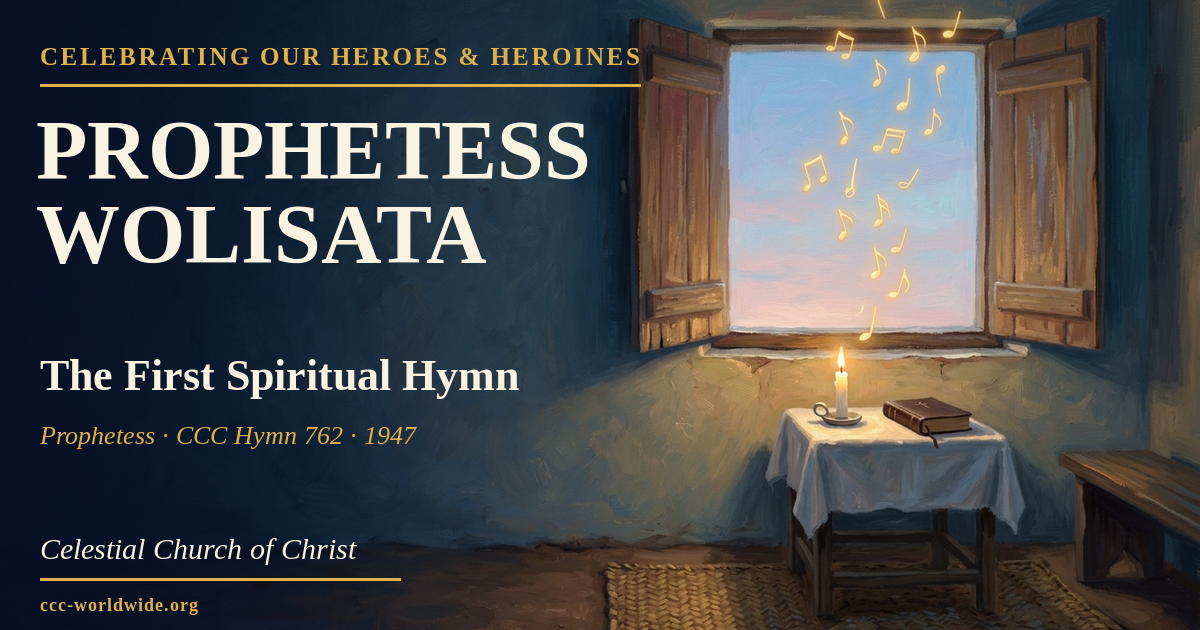
Today we honour Wolisata, the early prophetess through whom, according to the Constitution, the Church received its first spiritual hymn, preserved in our hymn book as Hymn 762. Before there was a church building, an order of service or a hymn book, the young congregation had a song, and it came through a woman.
The morning the Church was told to begin
On 29 September 1947 Papa Oshoffa received the Divine Order. In the first week of October, on the fifth day after it, the first worshippers were gathered with him early in the morning when word came that his commission was to found a new Church, and that he should start it right there in his own house.
In his supplement to the Church’s history, given to the Board of Trustees at Ketu on 22 May 1979, Papa Oshoffa recalled that the first song was given to them that same morning, in Yoruba:
The first song given to us was (in Yoruba) … We all sang this song together early that morning.
— Papa Oshoffa, Ketu, 22 May 1979
CCC Constitution (Nigeria Diocese, 1980), paragraph 77
Later that same day, in the evening, the Founder received the Covenant with Christ (paragraph 78). The first hymn and the covenant belong to the same first day of the new Church.
Her contribution lives on in our hymn book
Paragraph 77 tells us when the song was given. In its discussion of Holy Mary’s Day, the Constitution tells us through whom:
The very first spiritual hymn that was given to the Church through one of the early prophetesses of the Church (WOLISATA) … (Hymn No. 762 CCC Hymn Book)
CCC Constitution (Nigeria Diocese, 1980), paragraph 99(g), Holy Mary’s Day
Our hymn book has it as Hymn 762, “Ẹnyin ara ninu Kristi.” Its English version begins, “Oh ye, brethren in Christ Jesus.”
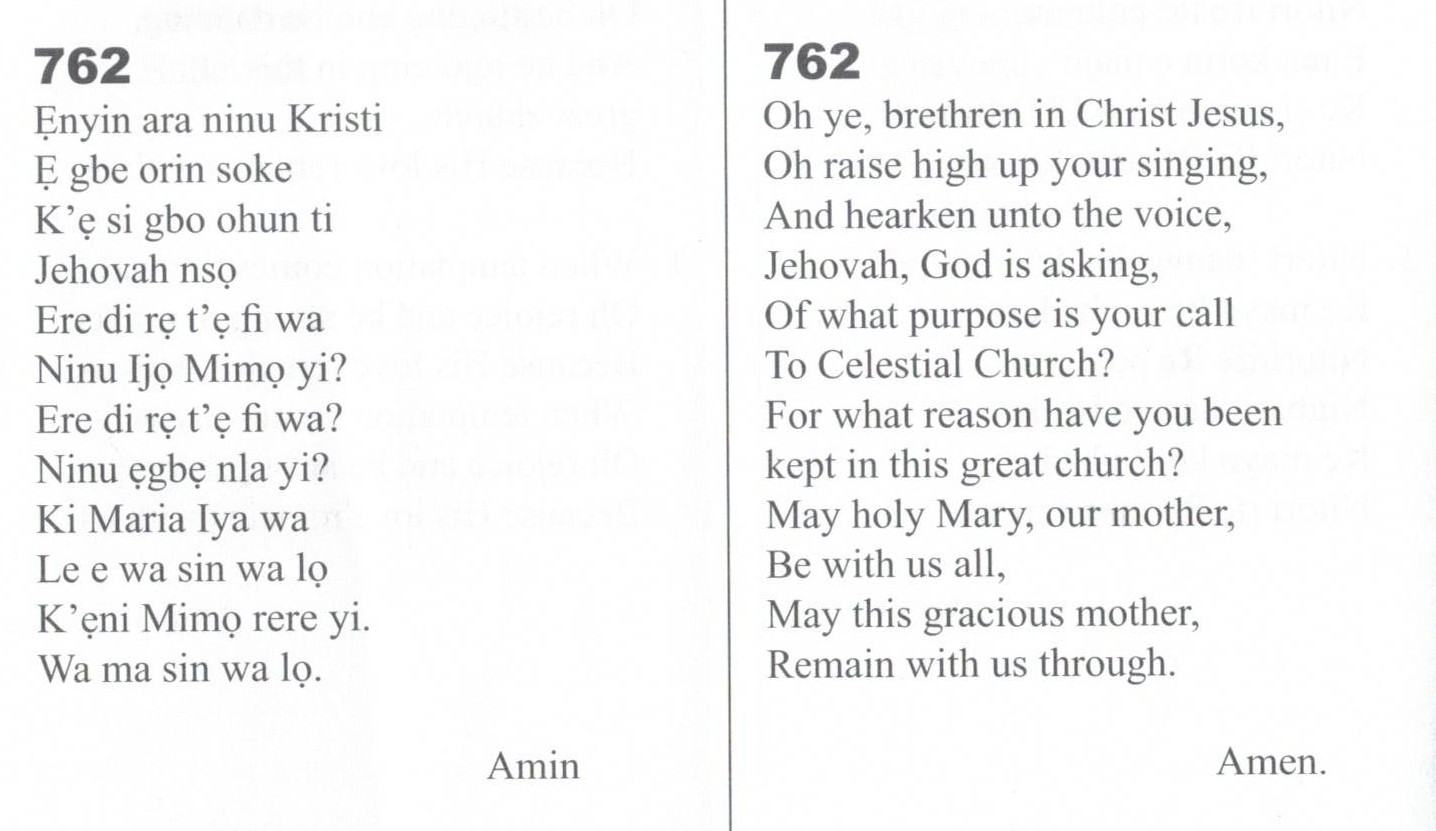
This gives us a direct connection between the history we are celebrating and the hymn book we hold today. When we turn to Hymn 762, we can remember Wolisata and the contribution associated with her name.
A person’s contribution can remain familiar long after their name becomes less familiar. We may recognise a melody, join in its singing, and carry its words in our hearts without remembering the person associated with its reception. Celebrating Wolisata encourages us to bring the name and the contribution together again.
A hymn that pointed thirty years ahead
The Constitution recalls Wolisata’s hymn when it explains Holy Mary’s Day, which commemorates the appearance of Holy Mary to the Pastor on 15 July 1977. It traces the significance of Holy Mary in the Celestial faith back to the earliest days of the Church, because the first spiritual hymn already asked for Holy Mary’s companionship.
“Significantly,” the Constitution continues, “thirty years later,” on 15 July 1977, the Pastor saw in a trance a lady clad from top to toe in blue. What the congregation sang on the first morning in 1947 was remembered when Holy Mary’s Day was established. A prophetess whose name appears only once in the Constitution is tied both to the Church’s first day and to one of its feast days.
The hymn asks us to consider our purpose
Hymn 762 calls the congregation to raise its singing, listen to God, and reflect on the purpose of its calling into the Church. It also asks for Holy Mary’s companionship.
For devotional reflection, its question about purpose deserves our attention:
- Why have we come to worship?
- What do we hope to receive, and what are we willing to offer?
- Are we prepared to listen, examine ourselves, and respond to God?
These questions remain valuable whenever we gather. Familiar surroundings and repeated routines can make it easy for our attention to wander. A hymn can draw us back to the purpose of the moment.
As we remember Wolisata, we can also consider our own calling. What contribution are we making to the community whose history we celebrate?
A woman’s place in our shared history
Wolisata’s inclusion in the Constitution matters to this celebration of heroes and heroines. It gives us a specific contribution to remember and teach. When we speak about women in the Church’s early history, we should make room for their names and the actions associated with them. In this series we have already remembered Iya Yaman, the Founder’s wife. Wolisata adds a prophetess whose gift gave the young Church its first hymn.
For younger members, learning such stories can deepen their understanding of the community they belong to. It helps them appreciate that our shared history includes people whose contributions took different forms. Some travelled. Some offered counsel. Some carried messages. Others are remembered in connection with the songs through which the congregation worshipped.
Each story deserves careful attention.
What sacred music asks of us
Wolisata’s place in this series also invites reflection on how we receive and use sacred music today. Her hymn shows us that from the first morning, before the Church had a building, it had a song.
A hymn can help people pray when they struggle to find their own words. It can gather many voices into one act of worship. It can carry remembrance, encouragement, repentance and hope.
Those entrusted with leading music therefore carry a responsibility. Choir members, instrumentalists, conductors, teachers and the congregation all contribute to the worship of the community. Preparation, humility and attentiveness help that service.
We can ask ourselves:
- Do we understand what we are singing?
- Do we give others room to participate?
- Do we approach the words with care?
- Does our preparation help the congregation worship with understanding?
These questions can turn remembrance into something practical.
Open the hymn book and remember
One meaningful way to honour Wolisata during this celebration is to turn to Hymn 762 together. Read its words. Consider its questions. Teach its message to younger members and explain why it belongs in this remembrance.
Parents can discuss it with their children: it is the first spiritual hymn of the Church, given through Prophetess Wolisata in the first week of October 1947. Choir leaders can help singers understand its meaning. Those leading a historical reflection can use it to connect the Church’s recorded beginnings with the congregation’s present experience.
Knowing where to find the hymn makes this history accessible. The story becomes something we can explore together through reading, reflection and worship.
Preserving the story responsibly
The constitutional passage gives us a clear starting point for honouring Wolisata, but it provides limited biographical information. It does not give her age, her family, her town or the years of her life.
We should respect those limits. A short historical reference can still be meaningful. We honour her faithfully by preserving what is recorded and distinguishing it from the reflections we draw for our own lives.
This is also a responsibility for those who hold family memories, parish records, photographs and other historical materials. Where reliable information survives, it deserves careful preservation so future generations can study it.
Our heroine deserves remembrance
Today we remember Wolisata, the early prophetess associated in the Constitution with the reception of the Church’s first spiritual hymn, Hymn 762.
Her story remains connected to a hymn we can still open, read, sing and teach to another generation. As we honour her contribution, may we become more attentive to the words we sing and more thoughtful about the purpose of our gathering.
Let us appreciate the people who serve through music today. Let us teach our children the history connected with our worship. And let us bring humility, understanding and willing hearts whenever we raise our voices before God.
Our celebration of heroes and heroines continues, with gratitude for the different people whose contributions form part of the Church’s story.
We remember the people. We honour their contributions. We give the glory to God.
Historical basis: Constitution of the Celestial Church of Christ (Nigeria Diocese, 1980): Papa Oshoffa’s supplement given to the Board of Trustees at Ketu on 22 May 1979 (paragraphs 77 and 78), and paragraph 99(g), “Holy Mary’s Day” (part 3), which names Wolisata and gives the hymn’s number; and the accompanying page from the CCC hymn book showing Hymn 762 in Yoruba and English. The Constitution does not record her years of birth and death or other details of her life. Reflections on worship, music and service are devotional applications of these sources. The picture is an illustration: no photograph of her is used.
#CelestialChurchOfChrist #Wolisata #Hymn762 #CelebratingOurHeroes #HeroesAndHeroines #WomenInChurchHistory #ChurchHistory #CelestialHymns #FaithAndService
@followers #followerseveryone #followmeonfacebook #follower #followformore #followersreels #followforfollowback
💬 Questions or need prayer? We are here any time:
- ☎️ 1-844-7-CCC-HUB (844-722-2482) – Toll-free: call free - ask Grace (LULI) any question, or ask her for prayer and our Prayer Minister or Comfort will pray with you right on the call. Text JOIN for service and event updates (Call · Text JOIN)
- 📱 959-CCC-CHUB (959-222-2482) – Call - ask Grace (LULI) any question, or ask her for prayer and our Prayer Minister or Comfort will pray with you right on the call - or chat with Grace on WhatsApp (Call · WhatsApp)
- 💬 +1 771-233-5885 – Chat with Grace (LULI) on WhatsApp: questions, prayer requests and more (WhatsApp)
Do you know more about Prophetess Wolisata?
Perhaps an elder in your parish, in Porto Novo, Lagos or elsewhere, has told you about her, or about how Hymn 762 was first sung. Join the CCC Worldwide Community and share what you know in the comments below. Joining is free.
Join and comment Already a member? Log in